The Memory of an Orange

This is my orange tree. Sprouted from a seed in 2017, he has grown to almost 5 rather leggy, awkward feet; he has stubbornly refused to make many branches, preferring to exert his energies into becoming one tall, spindly leafy stalk with two or three small branchlets like afterthoughts—and never where he was pruned, as all advice meant to coax him into making branches assured me would happen. As he sits in a very large pot on my front porch, I have had to explain to visitors what “that funny-looking tall plant” is. A month or so ago, however, I discovered that he’s decided to go in a different and exciting direction with his art, branching out at every node. And now he is starting to look like a tree. He’s not the glamorous bushy creature that my lime has become (I rescued that from the curb, where someone had left it after an unusual frost had battered it; it has rewarded me for not giving up on it by being quite a pretty lime.) He’s really kind of a punk.

Punk orange tree, with lovely new green leaves.

This stubborn cuss of a plant is a Citrus aurantium, the bitter or sour orange, also known as the Seville orange, the ur-orange of the modern fruit found in your local grocery store. DNA studies indicate that the species originated in the foothills of the Himalayas and spread thence westward. The sour orange reached Europe via the Umayyads; it is said that Ziryab himself, 9th-century musical prodigy and influencer before influencers were a thing, introduced the convention of orange juice for breakfast (that may be anecdotal, but someone had to do it, after all.) The oranges get mentioned more than once in my book, because the oranges represent something fundamental in the heart and soul of al-Andalus.

…And, also, I am enamored of the sour orange. Web pages will caution you that they aren’t really good for eating (except in marmalade, say), but I know that not to be true. To take a bite of one may be a rude surprise to one expecting the sweetness of the Valencia, navel, or blood orange, but they have a depth and dimension to their sour assertiveness that, frankly, I love; I know other people who feel the same. Their skin is very firm and thick; they aren’t easy to peel. The fruit itself is heavily fragrant—in fact, the sour orange is commonly used in perfumery: the honeyed-light sweetness of the flowers with an undercurrent of decay makes orange blossom absolute; the sharp, assertive, woody green citrus of the leaves and stems make petitgrain; then there is the oil from the fruit itself, a burst of sweet, sharp, and juicy. When you peel one of these oranges, it’s important to really dig your nails into the rind to savor the lovely oil scent, so thick and heady it’s like rhythm.

Orange blossoms are one of the best smells in the world, and I will see no debate on that. Paradise is perfumed with orange blossom, in my conception of it.

My tree was grown from a seed taken from a rather special tree. His progenitor lives on Sapelo Island, untended and mostly noted by visitors as a pretty novelty; as I mentioned, the fruit are not to most people’s taste, and tourists who pick the lovely fruit hoping for a sweet snack are usually disappointed (although the Gullah Geechee of Sapelo do use the sour-orange juice as a home remedy for coughs and colds; it’s mixed with honey, and, according to one of my friends, alcohol is usually involved.) There are five or six such feral sour-orange trees on Sapelo that I know of; this one is near the mansion, and by all rights should not be as impressive a tree as he is. He grows at the very foot of an ancient live oak tree; despite this formidable competition for resources, this orange tree is about 25 feet tall and not young. Every year, he scents the surrounding air with the benediction of his flowers and produces a beautiful crop of bright fruits. He’s a very hardy tree, having weathered numerous hurricane-and-tropical-storm seasons, half-hidden by the oak and not paid much mind except by the occasional strange person like me; I visited this tree regularly when I worked on the island (Hurricane Irma sent the island over a foot of storm surge; everything green suffered a bit from the inundation. He looked somewhat sad and drawn in on himself, so I took a bag of citrus fertilizer out there to him. I think it helped. Maybe.) Seville oranges are known for being tough and sturdy; they are often used as rootstock for sweet varieties for that reason (with age, the sweet oranges will “revert” to the rootstock; the oranges of such an aging tree are a bit dismaying. They taste like they should be sweet and they have the sweet-orange texture, but the flavor is bitter and chaotic, not sour and well-composed like that of a true Seville.)
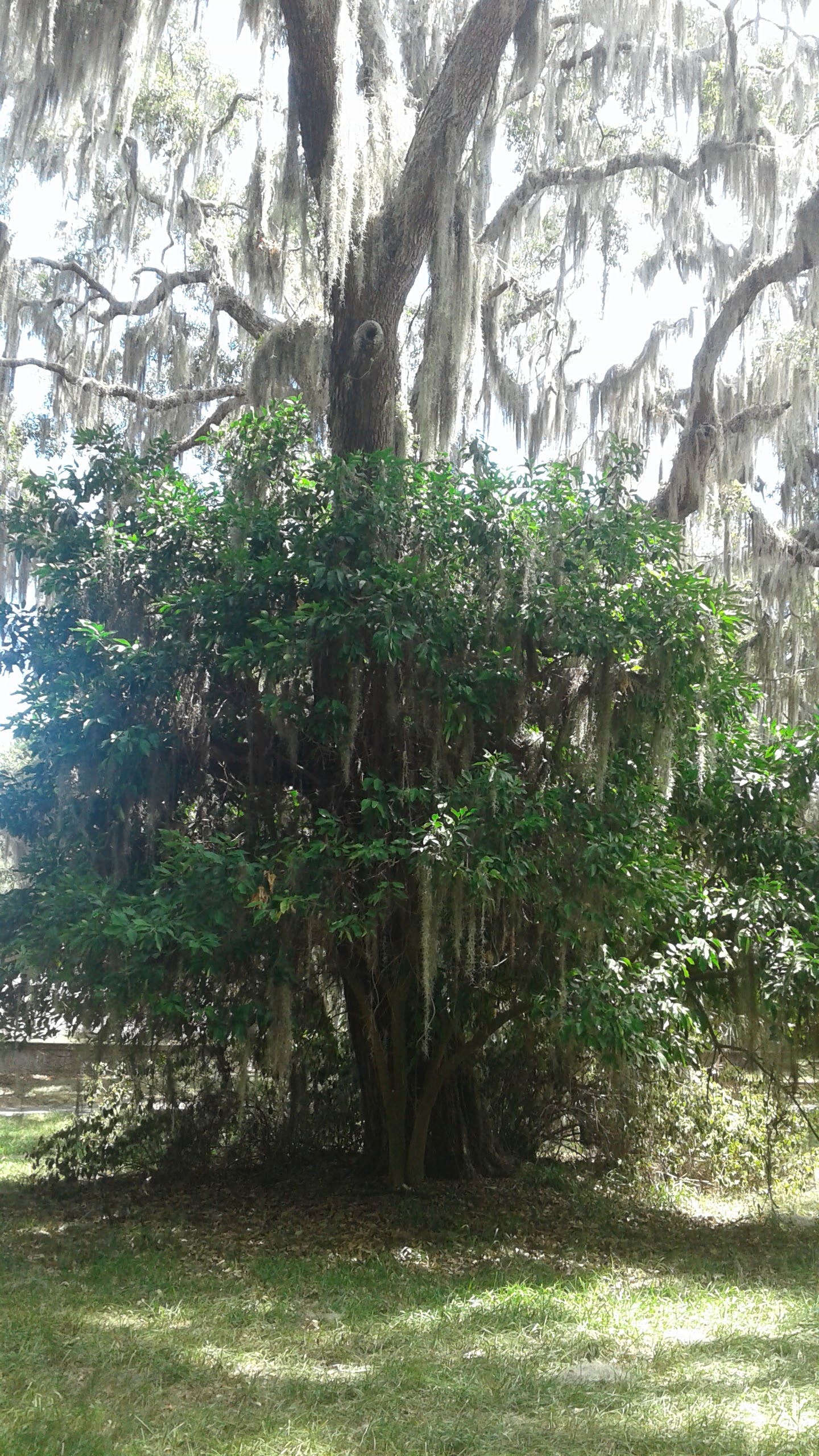
The parental tree. It’s hard to see the scale here, but he’s about 25-30 ft tall.
The live oak behind him is massive.

So what’s with the presence of feral Seville oranges on Sapelo, and elsewhere dotting the landscapes of Florida and coastal Georgia? The answer, of course, is the Spanish. The territory of La Florida comprised northern Florida and coastal Georgia in the 16th to 18th centuries. In the latter part of that era, coastal Georgia was “the Debatable Land,” with the English making inroads and the Spanish snatching back. The Spanish loved their oranges; there were even attempts to grow wheat and oranges as cash crops (see here for one discussion of this.) Sapelo was the site of one of the mission settlements that ranged along the coast of La Florida.
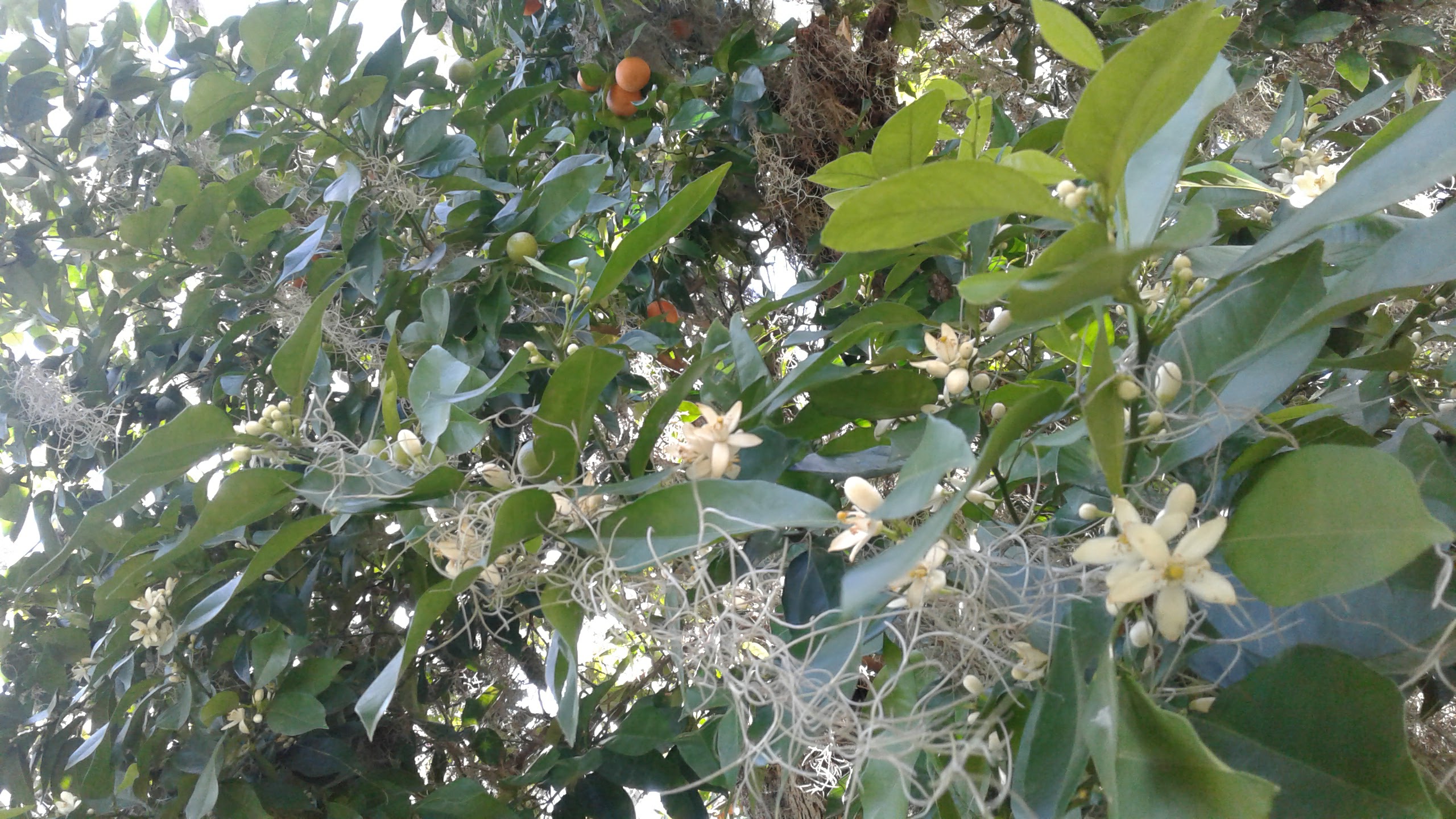
Parent tree in flower and fruit.

There were several such missions built during the late 16th-early 17th century period; the Mission de San Joseph de Zapala was in full use by about 1610, but I think it was started in 1594 (don’t hold me to that exact year; I’m too preoccupied right now to confirm it.) The Spanish moved in on the territory of the Guale people, who were already in the midst of a shakeup due to an epidemic and attacks by the Westo, a far-ranging tribe who had adopted a practice of capturing slaves from among southeastern peoples. The Guale had a settlement on Sapelo; the Spanish shouldered in and built their mission. Somewhat later, a group of Yamassee, who were likely refugees, moved onto the island as well. The Spanish interaction with the people of La Florida was always thorny (to put it mildly): Spanish exploration was explicitly “for cross and crown”; they were looking for riches and converts. Their view of the native people was not a good one; recall that this was the time of “limpieza de sangre” (purity of blood), a policy that viewed anyone with the “stain” of Muslim or Jewish blood as markedly inferior to “cristianos viejos”; I contend this ideology was a foundational template for modern white supremacy. Imagine how those who held that idea extended it towards indigenous Americans. True, there were those, especially among the Franciscans, who took a more benevolent stance, and people who have to live together at a small scale tend to learn to get along. Somewhat. But the Spaniards had their own agenda, which really wasn’t about seeing the people they encountered as equals.

Needless to say, the missions did have problems with uprisings from both the Guale and Yamassee (having read detailed accounts, I cannot say I blame them at all for rising up.) Furthermore, the missions were facing increasing incursions from the English, the English-backed (and armed) Westo, and French pirates. Over time, the mainland missions were closed and everyone therein moved to the island missions; eventually, all of the missions were consolidated onto Sapelo, as it was a defensible island. For a while. The Spanish eventually packed up in 1684. They did return in 1686 to drive off a settlement of Yamassee who’d remained near the old priest’s house (why did they drive them off? Spite?), and destroyed the remains of the mission and settlement. Including the groves of orange trees. The Englishman Capt. Dunlop, in his “Voyage to the Southward,” wrote of what he saw in 1687:

“Moving early we came about noon to Sapale…where we see the ruins of houses burned by the Spaniards themselves. We see the Vestiges of a ffort; many great Orange Trees cut down by the Spaniards in septr last…but all had been burned to Ashes last harvest by themselves…”

One can destroy a grove of fully grown trees, but there are always seeds.

These random feral sour oranges on the island are not the very trees a Yamassee or Spaniard picked fruit from, mind, as oranges don’t usually live to be 400 years old (there are rare examples of very old sour orange trees, but those have been cared for conscientiously for many years; it must be a remarkable burden to have to be mindful of one’s stewardship of an ancient living thing.) These were likely rooted from a seed dropped by a bird at the foot of a live oak, or a fruit eaten by an animal and then excreted. They are all tough cusses, living out their lives mostly ignored in a mostly wild landscape, each year offering the dazzling sweetness of their blossoms to the air and the bees, their perfumed and rough-skinned sour fruit to any creature who will eat them.

I am fascinated by the concept of epigenetic memory: that what an organism’s ancestors lived through survives in and alters its genetic patterns; it’s a more empirical (and therefore more respectable to those who may scorn the “fuzzier” concepts) form of ancestral memory. Like the dog or Bombyx mori, the orange tree is a species cultivated by humans. We have altered it on the genetic level so that it has adapted to us; therefore, I’m sure we are part of its epigenetic memory. Like the dog and the silkworm moth, then, it has an existence that is not ours and is apart from us, but it must on some level always be aware of us, the species that has etched our collective name in its DNA. I imagine these trees collecting and cataloging their memories of all of the people who have lived on the island–the generations of Gullah Geechee families, the rich men of the mansion, the doomed 18th-century French entrepreneurs, the Guale and Yamassee people, Captain Dunlop, the Spanish soldiers and priests. I imagine their roots holding the memory of the sunwarmed and well-watered soil of a garden in al-Andalus, or of being a dreaming seed carried westward in a pouch or pack along the Silk Road. It may be fanciful and even twee of me to say that, but on some level we all acknowledge the potential sentience of trees: there is a reason we all understand the concept of witness trees, trees which were present during a significant event in a significant place, and have survived long years since. These trees are landmarks in and of themselves, and we may touch the bark of a tree which was present at a particular time and wonder what it experienced and what it remembers.

My young tree unfurls his tender new leaves to the sun, having stretched himself out to what he deems a currently satisfactory height, no longer such a “funny-looking plant.” There are at least 3 other such young trees sprouted by me from seeds from that sturdy tree (one of the most sentient trees I’ve ever seen) and given to other people. They’re doing well. My tree hasn’t made blossoms and fruit yet, but I have a suspicion that will be coming soon. He’s flourishing, and I may have to get him an even bigger pot (at this rate, it’s going to have to be some massive vat soon; I’m living in a rental and I refuse to put him into the ground here.) He’s already got a very big pot and he seems quite content right now to grow and hold fast to whatever memories his family holds.

Writing and Self-doubt (Part I)

There are three things that have caused the most self-doubt in me in attempting to write this book: fear that it has no real readership (i.e., market), fear that I will get the history wrong in either small or fundamental ways, and fear that I will wind up writing something that cribs from someone else’s work, or basically repeats something someone else has done. I imagine these are things that pretty much every writer fears, although how much of each afflicts any given writer is probably subjective.

First, readership: I largely started writing this because it was a book I wanted to read, or at least, there were elements I wanted to see in a book that I had not found in combination anywhere, and I wanted to see them put together in a story that was relatively satisfying to me. But just because I want to read a particular book or find particular things interesting and worth exploring in fiction doesn’t mean that anyone else is clamoring for them. The book is a hybrid of genres: historical, mystery, fantasy. You have historical mysteries and historical fantasy as genres, why not all three at once? I mean, certainly, many books tend to have some kind of genre crossover, even genres that are hybrids to start with, but having all three might be a genre too many for some. Then there’s the topic: yes, people like historical fiction/historical mysteries, but the setting is less common and probably less appealing to many. If I were setting this in 9th century Britain, or 16th century Venice, or even just writing the main story from the Viking perspective, it would have greater appeal to a wider audience. I think (heck, I know) that setting any book in an Islamic-majority society, or with main characters who are Muslim, tends to lose a lot of Western readers. That’s a very large topic right there—that you can have Muslims in a story if they fill certain roles or act certain familiar-if-not-always-entirely-accurate tropes out that a large swath of readers are comfortable with, but not other roles—and worthy of its own discussion. Of course, that isn’t the only reason the ideas behind this might not appeal to most readers; maybe it’s too ridiculous, or not handled well, or maybe it’s that my story is really quite tedious. But there it is, and it’s inescapable: either it has broad enough appeal or it hasn’t. In the end, as far as getting it published goes, it doesn’t matter so much if it’s the most brilliantly written, historically accurate, fascinatingly plotted book possible if it isn’t something that people will want to read. That part I can’t control. Thus, just write it and see.

Second, historical accuracy: I fear that I have been writing something that is either riddled with small inaccuracies or has some larger historical flaw in a major premise. Should it be published, most readers are probably not going to notice small issues (and may even question some things that are actually accurate, and I already can guess a few of those), but there may be those readers…and I know this, because I have been one of them on occasion…who really do know the subject better than the writer. I know from experience that inaccuracies can pretty much spoil suspension of disbelief and mess up the story. Granted, there are two things to be said here in my own defense: one, I did a pretty fair amount of diligent research in world-building and fact-checking (for example, in the course of writing this, I have read four journal articles just on Andalusi plumbing, two of which were not in my native tongue) and can at least defend some of my questionable choices; two, unfortunately, there are some things just not known and one sometimes has to make educated guesses and take artistic license. Clothing, for example: there are very few extant garments from al-Andalus, certainly from this period (what we have is fragments of textiles, like tiraz bands); much has to be extrapolated from extant garments from other Muslim areas, or from art or written records. You can do a whole heap of research and still run into questions: here you are, trundling along, and you suddenly have to wonder: “Would people have been eating that? Are they sitting on chairs, or cushions? Yes, but were those perfume notes found in scents of the period? Would she have buttons on her sleeves, and was this color part of the dye palette of the time? How far away from this locale was that neighborhood in the 9th century? How many people fit into that kind of boat?” Sometimes I’d stop and look things up and try not to get sidetracked (fat chance); sometimes I’d recognize that sidetracking was far too likely, or that the answer wasn’t simple or readily found, or there were conflicting accounts…and I’d mark it as something to backfill later. Sometimes the answers just weren’t there, and sometimes if you don’t just keep writing you won’t write. On one or two occasions, I picked something that was possible even if not the most probable because it fit the story better (I tried not to do this at all, but I did create one character whose origins are improbable although not impossible.) I worry that someone will spot a particularly obnoxious, egregious, or utterly impossible flaw in the history, and it will be an utter disappointment to that person; I’ll get wind of their disappointment and possible scorn and feel very bad about it (getting ahead of myself in assuming it gets published and actually reaches the reading list of someone likely to feel disappointment and scorn in my historical flaws.) I made a lot of historical corrections as I went along and learned new things. It’s probably still error-riddled. At some point, I had to stop dithering and pulling out books and articles and just write.

Third, unintentionally plagiarizing/writing something someone else has done/doing something too similar to another writer’s work or that appears really derivative: this one terrifies me. As I said, I started writing a book based on what I wanted to read about and couldn’t find. I didn’t think this particular story had been told from these particular angles. In fact, finding anything written about this particular set of historical events was rare. And then as I was writing, the doubt started creeping in: well, Gaiman has done a lot of exploration of the nature of old gods no longer worshiped…could this wind up too American Godsish in theme, or like some arcs in Sandman? The only fiction I’m finding about al-Andalus seems to be written about the end of the era, about later in the era, or as part of the “clash of civilizations” (and mostly told from the Christian-Iberian POV), or is otherwise not like this…but is that all there is? I’m afraid that much of what is written by non-Muslim American and UK writers exploring Muslim culture of the period doesn’t feel authentic to me, however well-written it is otherwise; it feels as if they’re writing about something that they’re not really culturally comfortable/familiar with and they are sometimes over-relying on predictable tropes. I recognize that as a sweeping judgment, but I often do sense discomfort in authors uncertain of how to write these characters. Spanish writers have done much more with the era, which makes sense, and have a different mode of approach. I have to confess that my Spanish is now kind of rusty, and reading in Spanish takes about 3 times as long for me as English (my French is starting to get out of practice, too.) Am I rewriting someone else’s work unknowingly, only in English? Finding out what was out there in the first place was important, which meant exploring Spanish books in particular. Ah, look, Carlos Aurensanz wrote a trilogy of novels about the Banu Qasi; I’d better read at least the first one, since Musa ibn Musa shows up in my book, and it’s good to see what other writers have done with the period…all right; I’m not unintentionally treading all over Sr. Aurensanz’s work. Oh, and here’s Mario Villen Lucena’s 40 Dias de Fuego, about the Viking attack on Ishbiliya…ah, mierda, in the first chapter we are introduced to an Amazigh shepherd, uh-oh…O.K., whew, totally different book (warning: although it’s quite good, there’s a lot of graphic violence including depictions of sexual violence, which I tend to skip over when reading.) Back in the anglophone world, G. Willow Wilson has written a book set in al-Andalus featuring djinn. Oh, dear, I really like her stuff and I hope it’s not too similar in theme…well, it’s set at the fall of Granada. I will read it when I’ve finished writing this book (I’m reading and enjoying it now, matter of fact.) I don’t write in a particularly similar style, I think, and I’m clearly not being derivative of her. And so on. You get the gist. I could spend all of my time slowly reading Spanish novels and fretting about possibly surveying ground already mapped, or I could call it good and just write my book.

That’s many words I’ve written, all about the forces standing against me that happen to be in my own head when I have contemplated actually sitting down and writing a work of fiction that is set in a particular time and place, and has particular sorts of characters. Always there is the obnoxiously persistent voice, oily and overfamiliar, murmuring into my ear: How are you qualified to write about this in the first place? Why do you presume to do this?

Well, I probably am not “qualified.” And I might not have historical accuracy so flawless it stands as a masterwork of scholarship, at least regarding Andalusi indoor toilets*. I might not have a surefire bestseller which has themes that everyone can relate to and wants to read. I might wear too many inspirations on my sleeves, or be writing about events that other (better) writers have written books about. But regardless, I have just had to set all of that aside and say to the obnoxious voice, every time it pipes up: At least I’m actually writing it.

*These existed, yes, and there is evidence that they were ubiquitous: archaeological finds suggest that even poor homes in the city of Qurtuba had indoor plumbing. If you are time traveling and looking for a period that won’t be too difficult if you like hygiene and plumbing, al-Andalus is a good choice.

On the naming of things and people in books…at least my own.

One of the things that I find quite challenging in writing is choosing names. As a confession, the book in progress—and it’s in the throes of its final edits before I attempt submission now, mind—still has no name. I have titled the manuscript Those Without Voices, which may or may not be what I keep it as. Most likely it will not remain so, because I’m beginning to dislike it. I harbor grave doubts about my ability to name anything well, much less a book. Because I know my limitations, I simply labeled the file “Pomegranate” when I started writing it. No particular reason, except that I like both the fruit and the word, and it grows in southern Iberia. “Pomegranate” it remained almost entirely through its first 126,000-word draft. Eventually it became “The Voiceless Ones,” but that was less than optimal. Each iteration is smaller on the word count, too, as it should be.

The “voiceless” phrasing has to do with an Andalusi convention whereby it was common to call certain foreigners “voiceless” or “dumb ones”—i.e. they did not speak proper language. I’m not in love with the name; it works in the original but sounds a bit mawkish as a title in English. I hope I change it.

My first completed book manuscript was entitled A Bird in Exile, which is pretty phrasing, but in many ways did not fit it (I sometimes cringe when I think of that book; even though it was not poorly written, the plot was trite. Ultimately, it’s probably better that it found no publisher. “Do the best you can until you know better. Then do better.”) I can’t take credit for that pretty phrasing, though; it was from a line of Rumi. Which, in and of itself, is dangerous, as Rumi (or things that Rumi allegedly wrote but frequently did not, or “translations/interpretations” of his work that frequently bear little resemblance to the phrasing and meaning of the originals) has been overused as a font of rather commodified inspiration in a way that is sad to my inadequate Sufi heart.

Then there are the names of characters, which has been (and has always been) something of an effort. When one is writing historical fiction, there is a bit less latitude; the names have to be historically and culturally plausible. Writing a book set in al-Andalus in the 9th century gives one fairly narrow parameters for naming a given character, which should make it more straightforward, but it also gives one more opportunity to pick the wrong name. Why? Diversity.

Something that makes me impatient with much of the common understanding of al-Andalus is the highly limited narrative of it as a land of “Moors vs. Christians.” Which, beyond any acknowledgment of the way those lines blurred, completely dismisses the existence of Sephardic Jews, who were an integral and very influential part of Andalusi society from the very beginning right up until the bitter end. The erasure of Jews in that narrative was not accidental, and it would be good for people to challenge themselves on it when they reflexively break it down to “Moors and Christians.” It was a strikingly diverse society, and this was by no means a new thing: the Iberian Peninsula has seen waves of immigration and colonizing from very early times, from Greeks and Phoenicians to Celts and Carthaginians, Romans, Alans, Suebi, Visigoths. I would point out once more that Iberia had a significant Jewish population early, as well. Then there were the Tartessians, whose origins no one is exactly certain of (they may have been indigenous), although they were probably not aliens (there is an unfortunate line of modern occultist thought that this was the case. You should not be surprised.) On the other hand, they held their mythical progenitor to be Geryon, who had either several heads or extra limbs, so that’s not completely off the table. I digress; needless to say the Iberian Peninsula had seen the comings and goings (and stayings) of many peoples. This is not an exhaustive list, either.

All this, poured into a land of Iberians and Basques (Basques of course antedate everyone.) Add to this mixture the arrival in the 8th century of Arabs (who had their own subcultural group differences), Imazighen, African peoples from south of the Sahara to the north and east, and then people like the Saqaliba, Eastern Europeans brought in largely by the slave trade. Throw in less-repellent forms of trade and you have even more people coming in from even further-flung areas, because al-Andalus was pretty cosmopolitan despite getting sneered at as the backwater of the Islamic world, and it gets even more complex. Then again, Christian Iberians were hardly a monolithic collective; there was a cultural divide among Visigoths and the greater Celt-Iberian and longer-assimilated population, even in their Christianity. The Visigoths, who came in from central Europe as clients during the Roman period and filled the power vacuum after the Romans, converted to Christianity early—but their Christianity initially was Arianism, unlike most of the other Christians of Iberia, until the Visigoths changed course on Arianism in 589 with the Council of Toledo. ‘Twas the Visigoths (again, not an indigenous group; they were colonizers, too) who were in power when Tariq ibn Ziyad sallied forth and began the Umayyad conquest of Iberia.

Even among the people lumped together as Muslim “Moors” (n.b.: this word really isn’t a thing), Imazighen are not Arabs, even when Arabized, and even their take on Islam had some differences due to inherent cultural differences and social factors. Furthermore, there were the muwalladun, the people who converted. I could break it down further, but understand that each group had their own cultural context. Inherent cultural differences inform people’s choices, even (especially) in a pluralistic society, even with assimilation and cultural exchange and colonization.

So what has that to do with naming characters? Ah, see, there is a point to my rambling. That point being that it isn’t enough to pick “Muslim” names and early Spanish “Christian” names, because all of those various peoples had different names and naming conventions, and every group added something to the giant Iberian pot as they assimilated.

I knew better than to give everyone names in Arabic or Spanish to show the difference, because that’s the lazy dichotomy, and it’s not historically or culturally accurate. Half of the characters I use were real people, anyway, so I had fewer names to worry about; those characters had ready-made names of their own. But despite all of my reading and research, despite knowing the various ways that names in Arabic, for example, are put together, I often found myself drawing a blank when having to name a character. Far too often, as a placeholder, I’d give someone the first random name that popped in that was moderately appropriate. I’d change it later, I told myself. The net effect was that I had people with decent Arabic names (although I had to check frequently to make sure I wasn’t repeating or giving characters names that were too similar), and some with decent Amazigh names, and…well, heck, what were the Spaniards going to be? Who were they going to be?

There are lists of names found in old documents—al-Andalus was a society with a strong sense of the power of the written word, and a tendency for robust administration and record-keeping, fortunately; some of that even survived the zealous destruction of records and books after the fall of Granada—and seeing the lists reminds you of how very diverse the society was. Here are Visigothic names, which look distinctly Central European; here are names that are Hispanicized Arabic or Amazigh; here are names that are clearly Roman Latin evolving into Spanish and Portuguese (and languages like Catalan.) Some were very Roman, some almost anachronistic in how Spanish they appear. And over here, these are the Basque names, which no one else would have, but which Basques certainly would. Don’t forget that slaves were frequently given Arabic names that were diminutive, descriptive, or words for objects. I have one enslaved character who retains his original cultural name; that was a very deliberate choice, as it said something about the character of the person he served. This character is also an oblique nod to Bedr, the formidable Greek freedman of Abd ar’Rahman I, if not in naming convention.

For a while, many of the “placeholder” names I grabbed were Visigothic and few were appropriate, as few of the characters themselves were of Visigothic heritage. I confess that I was being lazy. I went back and devisigothified several names in the second run-through. I gave a character a soldier’s nickname, with the intent of introducing a backstory (I keep most character’s backstories in my head, from brief sketches to a full biography), and then realized that was not going to happen, and the name looked silly and wrong without that. So off I went to find a name appropriate for an aging soldier of Romanized Iberian family; I settled on one that had the same kind of rhythm as the nickname, and is completely in keeping with the character.

I had to change names for other reasons: a relatively minor character had a name that reads similar enough to a more major character’s name to cause confusion for two beta readers, so that had to be changed. And so on. As an aside, in that pretentiously-titled “Fragment” I posted a while back, two of the characters have since been renamed (of note also: I recognized that the formation of plurals in the Basque language does not use an “s” and am assuming that extends to earlier forms of the language; thus iainkoak, not iainkos. It still may not be correct, but I’ve done some due diligence in order to use that one word, which I honestly felt was important in context. If any Euskadi speakers correct me, I’d welcome it.)

What of the djinn in the book? Once again, I treated them as a diverse population, as they would be: some are native in their affinities and origin, some Roman or Romanized, some Muslim. Therefore, they got names that reflected that, although only a few are “real” as in human names; most are not quite human names, but they still had to reflect the particular djinn’s heritage (well, cultural affinity), so they’re mostly adaptations of human names from those cultures. I suppose I could have created entirely new, alien, djinn names, but these are the ones that took…and recall I am not good at naming, so if I’d created unique “djinn language” names, they would have probably been really silly.

I struggle with names, both remembering them and choosing apt ones, but I think the names for characters in this book now make sense. Mostly. Still, a risk in writing history is having a broken or inadequate understanding of the cultural mores and nuances, and I’ve possibly picked a wholly inappropriate name here or there. On the whole, though, I am satisfied and feel at the least I can defend my naming choices with some coherence.

I would still like to come up with a really bang-up name for the book, yes.

Fragment: The Voiceless Ones

What I’ve just written tonight…I didn’t know when I started this chapter with Juba (the shepherd, not the king he was named for) and Scribonius that it was going to involve a pair of Basque women, but nevertheless, here we are. This is unedited, by the way. I’m also still worried that Scribonius, a name that fell into my brain as being the name I needed to use, is something I’ve seen elsewhere and isn’t for me to use because it’s from some other work, but a search pulled up nothing, so Scribonius he is. If you’re wondering why a djinn would have a Roman name, there is a reason. It’s got logic in the story.

It was true that Roderic’s wife Arantxa was not best pleased when her husband returned bearing a bloody, hulking boar carcass and an only slightly less bloody and hulking Muslim stranger, but she was less vexed than her face suggested: her lower lip always jutted just enough to look like a pout, and her long narrow-jawed face always managed to look faintly displeased unless she was smiling broadly. She was somewhat mistrustful, and exasperated (so typical of this man of mine to do this, she thought, but not without affection). But she unbent quickly enough; the boar would be worth the work, and was freshly killed, and the boy was clearly country folk of a kind she recognized well enough. He was humble and polite, and had immediately set to helping her husband, despite his evident fatigue. When she directed them to wash up, he’d been the first to do so.

            As he dried his face and hands on a rag, Arantxa saw her mother Erdutza peering at the boy as she shelled peas. Erdutza gestured at her daughter to come closer.

            “What is it, Ama?”

            “That boy has a iainko with him. You can’t see it?”

            “Ama, hush. There are no iainkos. There is only God the Father and Son.”

            “Oh, there is only God the Father and the Son and the Holy Spirit as Lord of all…but you are wrong if you think there are no more iainkos. And that boy has one with him.” The older woman frowned thoughtfully at the peapod in her hand. “It’s not a bad iainko, though. It protects him.”

            “Ama…” Arantxa trailed off, knowing it would be fruitless to argue. Besides, under it all, her mother was right: there were still iainkos, no matter how good of a Christian one was. She squinted intently at the boy herself, knowing that sometimes she could see what her mother saw.

            Then she saw it, like pale mist, squatting patiently on insubstantial haunches. She could not make out its form, just that it was there and was quite large.

            Without taking her eyes off it, she asked her mother, “What does it look like to you? All I see is mist.”

            “He is like a bull. That’s very good, very strong. An old iainko, then. He’s wearing trousers, though.”

            “Trousers? Is that bad?”

            Erdutza shrugged. “They used to wear clothing like our ancestors wore, or they wore nothing. Not trousers with flowers on them.”

             The old woman nodded, as if in greeting, her eyes not moving from where the iainko crouched.

            “Ama, did it…has it noticed us?”

            “He has. He’s watching us as we watch him. Nothing to worry about, though. He is respectful, even if he’s wearing trousers.” She reached for another peapod.

            At supper, Scribonius was content to remain outside of Juba’s head, squatting in a corner and observing. Juba found himself taking great comfort from being with these people; they reminded him of his own family. The food was simple but plentiful; Roderic’s wife Arantxa had made a portion of mutton for Juba. Everyone else feasted on fresh roasted pork. Juba tried hard not to think of where it had come from, as he knew he’d be once more seeing that look of resignation and acceptance of loss in the animal’s eyes if he even looked at the roast.

            “You know, this is not at all a terrible or ignoble end for that boar, boy,” Scribonius remarked. “It’s a sacrifice, and what could be more noble and beloved by Allah than that? When you thought that the boar knew he was dying, you were correct. He did know. In that moment, he knew he was a sacrifice, and he accepted that. Like Ishmael. SubhanAllah.”

            Juba considered this, and started to reply, remembering just in time that others could not hear or see the djinn, and that responding would not be wise. He nodded instead, glancing around the table. To his dismay, he saw that the old woman, the one with the same intense, downturned eyes as Roderic’s wife, was watching him. She turned to look at the corner where Scribonius squatted, then looked back at Juba before attending once more to her food.

            “She can see and hear me, boy. She has a gift for it. Her daughter does too, but not as much. Have no fear of her, boy. She’s a fine woman.”

            The old woman pursed her lips into a smile and nodded, but did not look up from her bowl.

            “They’re Basques, these women, and Basques have always had more than their fair share of such gifts. It’s not for anyone to know why. Well, we know why, but it’s not really for you to understand.”

            Juba once again had to bite his tongue to prevent himself from responding.

            “That’s the other lesson I wanted to give you about the story of Musa and al-Khidr, boy…even the best of humans, the most perfect of humans, is still human. You lot are limited to only that which humans can know and understand, even if you want more. It’s really to your credit as a breed that you want to know more than you have the capacity for. Still, it can get exceedingly tiresome for the rest of us, badgering us with your questions as you do.”

            The old woman snorted with laughter at that, turning it into the pretense of a cough when everyone else paused to look at her.