The Memory of an Orange

This is my orange tree. Sprouted from a seed in 2017, he has grown to almost 5 rather leggy, awkward feet; he has stubbornly refused to make many branches, preferring to exert his energies into becoming one tall, spindly leafy stalk with two or three small branchlets like afterthoughts—and never where he was pruned, as all advice meant to coax him into making branches assured me would happen. As he sits in a very large pot on my front porch, I have had to explain to visitors what “that funny-looking tall plant” is. A month or so ago, however, I discovered that he’s decided to go in a different and exciting direction with his art, branching out at every node. And now he is starting to look like a tree. He’s not the glamorous bushy creature that my lime has become (I rescued that from the curb, where someone had left it after an unusual frost had battered it; it has rewarded me for not giving up on it by being quite a pretty lime.) He’s really kind of a punk.

Punk orange tree, with lovely new green leaves.

This stubborn cuss of a plant is a Citrus aurantium, the bitter or sour orange, also known as the Seville orange, the ur-orange of the modern fruit found in your local grocery store. DNA studies indicate that the species originated in the foothills of the Himalayas and spread thence westward. The sour orange reached Europe via the Umayyads; it is said that Ziryab himself, 9th-century musical prodigy and influencer before influencers were a thing, introduced the convention of orange juice for breakfast (that may be anecdotal, but someone had to do it, after all.) The oranges get mentioned more than once in my book, because the oranges represent something fundamental in the heart and soul of al-Andalus.

…And, also, I am enamored of the sour orange. Web pages will caution you that they aren’t really good for eating (except in marmalade, say), but I know that not to be true. To take a bite of one may be a rude surprise to one expecting the sweetness of the Valencia, navel, or blood orange, but they have a depth and dimension to their sour assertiveness that, frankly, I love; I know other people who feel the same. Their skin is very firm and thick; they aren’t easy to peel. The fruit itself is heavily fragrant—in fact, the sour orange is commonly used in perfumery: the honeyed-light sweetness of the flowers with an undercurrent of decay makes orange blossom absolute; the sharp, assertive, woody green citrus of the leaves and stems make petitgrain; then there is the oil from the fruit itself, a burst of sweet, sharp, and juicy. When you peel one of these oranges, it’s important to really dig your nails into the rind to savor the lovely oil scent, so thick and heady it’s like rhythm.

Orange blossoms are one of the best smells in the world, and I will see no debate on that. Paradise is perfumed with orange blossom, in my conception of it.

My tree was grown from a seed taken from a rather special tree. His progenitor lives on Sapelo Island, untended and mostly noted by visitors as a pretty novelty; as I mentioned, the fruit are not to most people’s taste, and tourists who pick the lovely fruit hoping for a sweet snack are usually disappointed (although the Gullah Geechee of Sapelo do use the sour-orange juice as a home remedy for coughs and colds; it’s mixed with honey, and, according to one of my friends, alcohol is usually involved.) There are five or six such feral sour-orange trees on Sapelo that I know of; this one is near the mansion, and by all rights should not be as impressive a tree as he is. He grows at the very foot of an ancient live oak tree; despite this formidable competition for resources, this orange tree is about 25 feet tall and not young. Every year, he scents the surrounding air with the benediction of his flowers and produces a beautiful crop of bright fruits. He’s a very hardy tree, having weathered numerous hurricane-and-tropical-storm seasons, half-hidden by the oak and not paid much mind except by the occasional strange person like me; I visited this tree regularly when I worked on the island (Hurricane Irma sent the island over a foot of storm surge; everything green suffered a bit from the inundation. He looked somewhat sad and drawn in on himself, so I took a bag of citrus fertilizer out there to him. I think it helped. Maybe.) Seville oranges are known for being tough and sturdy; they are often used as rootstock for sweet varieties for that reason (with age, the sweet oranges will “revert” to the rootstock; the oranges of such an aging tree are a bit dismaying. They taste like they should be sweet and they have the sweet-orange texture, but the flavor is bitter and chaotic, not sour and well-composed like that of a true Seville.)
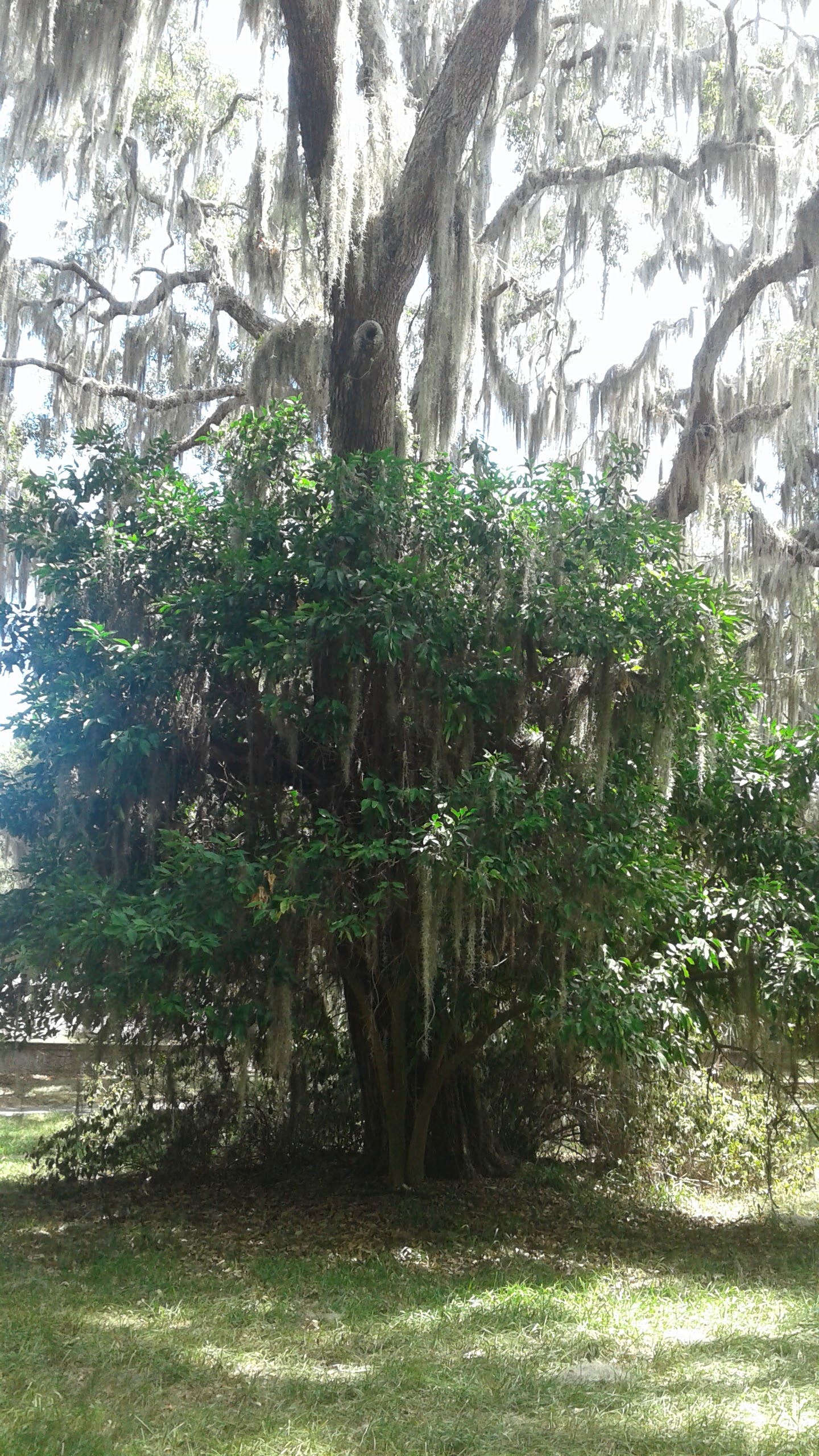
The parental tree. It’s hard to see the scale here, but he’s about 25-30 ft tall.
The live oak behind him is massive.

So what’s with the presence of feral Seville oranges on Sapelo, and elsewhere dotting the landscapes of Florida and coastal Georgia? The answer, of course, is the Spanish. The territory of La Florida comprised northern Florida and coastal Georgia in the 16th to 18th centuries. In the latter part of that era, coastal Georgia was “the Debatable Land,” with the English making inroads and the Spanish snatching back. The Spanish loved their oranges; there were even attempts to grow wheat and oranges as cash crops (see here for one discussion of this.) Sapelo was the site of one of the mission settlements that ranged along the coast of La Florida.
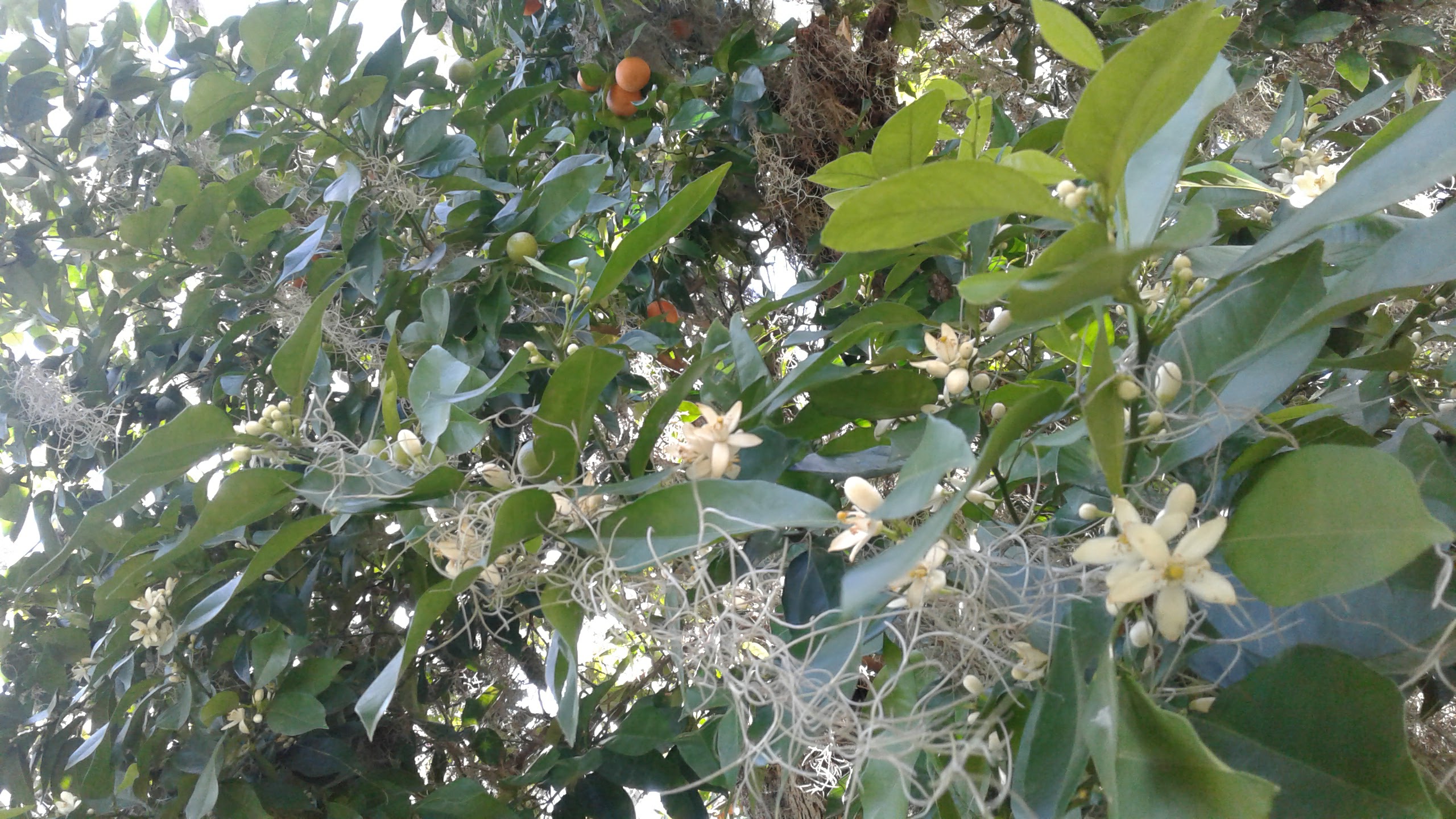
Parent tree in flower and fruit.

There were several such missions built during the late 16th-early 17th century period; the Mission de San Joseph de Zapala was in full use by about 1610, but I think it was started in 1594 (don’t hold me to that exact year; I’m too preoccupied right now to confirm it.) The Spanish moved in on the territory of the Guale people, who were already in the midst of a shakeup due to an epidemic and attacks by the Westo, a far-ranging tribe who had adopted a practice of capturing slaves from among southeastern peoples. The Guale had a settlement on Sapelo; the Spanish shouldered in and built their mission. Somewhat later, a group of Yamassee, who were likely refugees, moved onto the island as well. The Spanish interaction with the people of La Florida was always thorny (to put it mildly): Spanish exploration was explicitly “for cross and crown”; they were looking for riches and converts. Their view of the native people was not a good one; recall that this was the time of “limpieza de sangre” (purity of blood), a policy that viewed anyone with the “stain” of Muslim or Jewish blood as markedly inferior to “cristianos viejos”; I contend this ideology was a foundational template for modern white supremacy. Imagine how those who held that idea extended it towards indigenous Americans. True, there were those, especially among the Franciscans, who took a more benevolent stance, and people who have to live together at a small scale tend to learn to get along. Somewhat. But the Spaniards had their own agenda, which really wasn’t about seeing the people they encountered as equals.

Needless to say, the missions did have problems with uprisings from both the Guale and Yamassee (having read detailed accounts, I cannot say I blame them at all for rising up.) Furthermore, the missions were facing increasing incursions from the English, the English-backed (and armed) Westo, and French pirates. Over time, the mainland missions were closed and everyone therein moved to the island missions; eventually, all of the missions were consolidated onto Sapelo, as it was a defensible island. For a while. The Spanish eventually packed up in 1684. They did return in 1686 to drive off a settlement of Yamassee who’d remained near the old priest’s house (why did they drive them off? Spite?), and destroyed the remains of the mission and settlement. Including the groves of orange trees. The Englishman Capt. Dunlop, in his “Voyage to the Southward,” wrote of what he saw in 1687:

“Moving early we came about noon to Sapale…where we see the ruins of houses burned by the Spaniards themselves. We see the Vestiges of a ffort; many great Orange Trees cut down by the Spaniards in septr last…but all had been burned to Ashes last harvest by themselves…”

One can destroy a grove of fully grown trees, but there are always seeds.

These random feral sour oranges on the island are not the very trees a Yamassee or Spaniard picked fruit from, mind, as oranges don’t usually live to be 400 years old (there are rare examples of very old sour orange trees, but those have been cared for conscientiously for many years; it must be a remarkable burden to have to be mindful of one’s stewardship of an ancient living thing.) These were likely rooted from a seed dropped by a bird at the foot of a live oak, or a fruit eaten by an animal and then excreted. They are all tough cusses, living out their lives mostly ignored in a mostly wild landscape, each year offering the dazzling sweetness of their blossoms to the air and the bees, their perfumed and rough-skinned sour fruit to any creature who will eat them.

I am fascinated by the concept of epigenetic memory: that what an organism’s ancestors lived through survives in and alters its genetic patterns; it’s a more empirical (and therefore more respectable to those who may scorn the “fuzzier” concepts) form of ancestral memory. Like the dog or Bombyx mori, the orange tree is a species cultivated by humans. We have altered it on the genetic level so that it has adapted to us; therefore, I’m sure we are part of its epigenetic memory. Like the dog and the silkworm moth, then, it has an existence that is not ours and is apart from us, but it must on some level always be aware of us, the species that has etched our collective name in its DNA. I imagine these trees collecting and cataloging their memories of all of the people who have lived on the island–the generations of Gullah Geechee families, the rich men of the mansion, the doomed 18th-century French entrepreneurs, the Guale and Yamassee people, Captain Dunlop, the Spanish soldiers and priests. I imagine their roots holding the memory of the sunwarmed and well-watered soil of a garden in al-Andalus, or of being a dreaming seed carried westward in a pouch or pack along the Silk Road. It may be fanciful and even twee of me to say that, but on some level we all acknowledge the potential sentience of trees: there is a reason we all understand the concept of witness trees, trees which were present during a significant event in a significant place, and have survived long years since. These trees are landmarks in and of themselves, and we may touch the bark of a tree which was present at a particular time and wonder what it experienced and what it remembers.

My young tree unfurls his tender new leaves to the sun, having stretched himself out to what he deems a currently satisfactory height, no longer such a “funny-looking plant.” There are at least 3 other such young trees sprouted by me from seeds from that sturdy tree (one of the most sentient trees I’ve ever seen) and given to other people. They’re doing well. My tree hasn’t made blossoms and fruit yet, but I have a suspicion that will be coming soon. He’s flourishing, and I may have to get him an even bigger pot (at this rate, it’s going to have to be some massive vat soon; I’m living in a rental and I refuse to put him into the ground here.) He’s already got a very big pot and he seems quite content right now to grow and hold fast to whatever memories his family holds.

Gardens: Impressions de Giverny & Confessions of a Garden Gnome

The Fort & Manle scents are incredible, but if one criticism can be levied at them, it’s that they’re not very “accessible.” They’re dramatic and memorable, but not necessarily everyday crowd-pleasing scents. Right?

Well, there actually are a few in the box that gainsay that. Two in particular, which are closely aligned in scent. Both are scented stories about gardens.

Monet's Jardin à Giverny
One of the many paintings of le Jardin à Giverny, by (surprise) Monet.

Impressions de Giverny was inspired by Le Jardin à Giverny; as the Fort & Manle site puts it, it is intended to be “[a]n olfactive journey of Monet’s vision for a Japanese garden in the heart of Normandy.” And it is without a doubt delightful, as well as being a scent that I could happily wear every day.

It is literally a fruity floral, but it defies the conventions of the description. As the story of a very specific garden both Eastern and Western, its elements are balanced between East and West. And the balance extends even further: under the fruits and flowers are greenery and earth.

The listed notes are yuzu, bergamot, red apple, magnolia, rose, tuberose, osmanthus, orange blossom, fig leaf, coriander, tulip, neroli, mango, ylang, ambergris, benzoin, musk. See what I mean? Fruity floral, green and earthy. It starts as florals, light and delicate, and moves into fruit, bright and delicious. It intrigues me that of the florals, the one that stands out most distinctly is the almost syrupy sweetness of osmanthus. The first fruits are the citrus, bergamot and yuzu, but the sweet piney edge of mango shows up a little later. This is the play of light and sweet over deep and aromatic. Note that both the fruits and flowers used are on the sweet and light side, so this could be overwhelming, if it weren’t for the solid base. A bit later on…ah, THERE’S the apple, with woody, almost cedarlike notes that I suspect are fig leaf and coriander. There isn’t a single bad or harsh note in this; it’s lovely, and everything blends beautifully. It’s distinctive but not overpowering. There is actually not a thing about this scent I could criticize, other than the fact that I wish it had a bit more sillage.

So, Garden No. 2, a more conventional garden than Monet’s…under the watchful eye of its steadfast guardian, the garden gnome. This one is decidedly the sister scent of Giverny; they share many notes. Gnome’s include the following: cedar, musk, Sicilian bergamot, coriander, yuzu, pink pepper, lily of the valley, mango, rose, violet leaf, ambergris, amber. Striking similarities, but where Giverny is predominantly fruity-floral, the Gnome veers into earthier, more herbal territory.

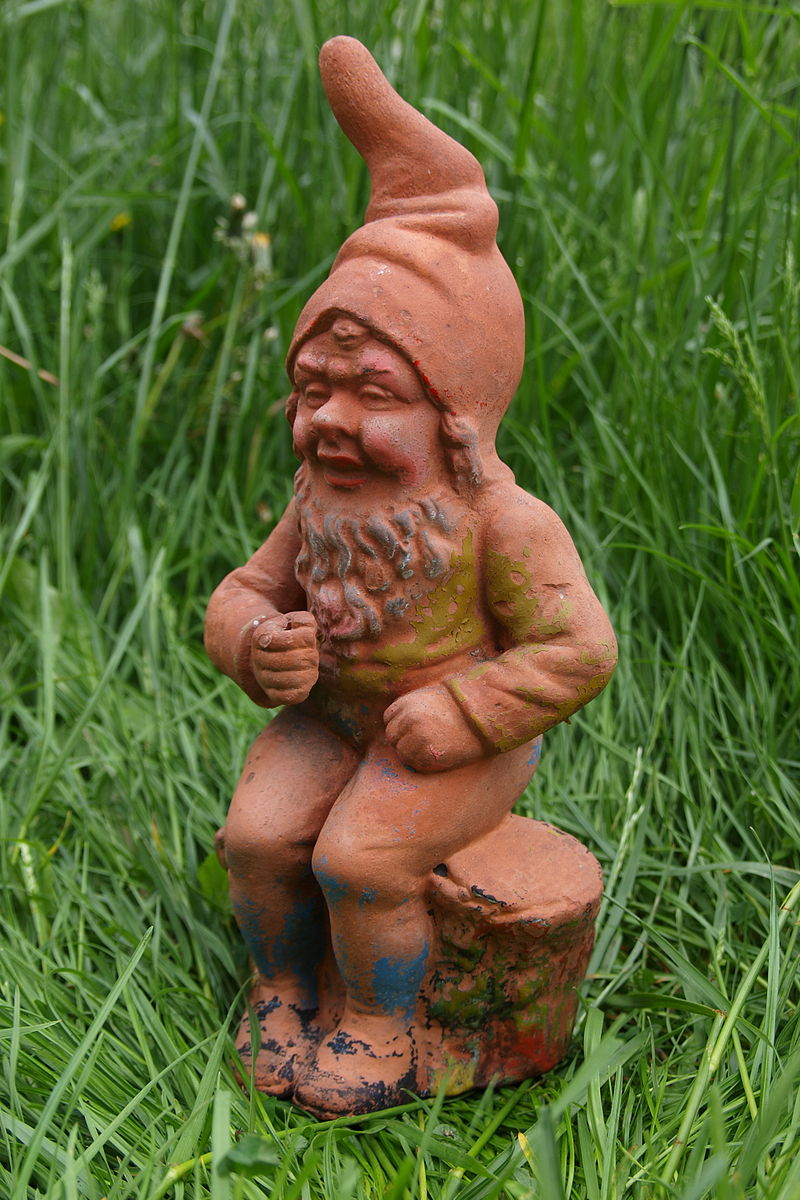
You will not mess with his garden (Antique German garden gnome image from Wikipedia).

And my own confession: at first I wasn’t sure I was down with the Gnome. One of the notes in this is sharp, almost piercing at the opening; it’s on the whole a more herbal and less floral scent than Giverny. I frowned a bit at it on first wearing, thinking this might be the one F & M I wasn’t crazy about. Happily, it grew on me, no pun intended. That sharp scent offsets the other elements, and pulls the story of the scent together. It makes sense that Confessions of a Garden Gnome would be the earthier garden scent; it’s the garden perceived at ground level, as a garden gnome would experience it. Which is really quite brilliant.

These two are the F & M scents that for me have garnered the most comments and compliments; they’re less dramatic than the others, and perhaps more conventional in composition than some of the others, but they are still unusual and memorable. If I were to recommend a “starter” scent for someone less intrepid about scents, it would be one of these. Giverny might be my very favorite in terms of sheer versatility alone. Both are unisex, like the other offerings, with Giverny being perhaps a bit more on the feminine side of the spectrum and Gnome a bit more on the masculine. That is of course highly subjective.

Wearing a garden is a beautiful idea, and these are both beautiful interpretations of that idea.

I’m not done with these yet. I still have Bojnokoff, Maduro, Amber Absolutely, Forty Thieves, and the big daddy of them all, Süleyman Le Magnifique, to review. On the non-F & M samples, I haven’t talked about the rather weird Functional Fragrance yet, and…am I missing something else? We’ll see.

Short takes: Sundrunk & Atropa Belladonna

Dear Diary:

It’s been so long. I’m trying out for the Drama Clu–no, that’s not it. I think I’m funny. But really, it has been a minute. I started a new job a month ago, and so my schedule, including time to write about perfume, has gone wonky.

I’ve got a stack of smells still to expound upon. I’ll start with two short takes on two of the samples: Sundrunk, by Imaginary Authors, and Atropa Belladonna, by Shay & Blue.

Imaginary Authors is a kind of concept house, sort of like a prog-rock album. The idea is that their scents are inspired by made up books by made-up authors. The packaging is meant to evoke a certain kind of mid-century book cover. The copy always includes an excerpt from one of these imaginary books by an imaginary author.

Here’s the one for Sundrunk:

Woozy and warm from the sun, we shared an orange pop and watched the surfers’ last lines of the day.

An excuse for me to use another random surfin’ photo!

Photo by Nathan Cowley from Pexels

Well, honestly, I’d kind of like to read more. Who are these people? What beach were they on? What were they doing afterwards? But of course, we’ll never know. Because it’s imaginary. It’s pretty meta, really. This may be a little pretentious, this concept, but that doesn’t mean it can’t deliver.

So, moving right along to Sundrunk…the notes? “Neroli, rhubarb, honeysuckle, rose water, orange zest, first kiss.” Now, there’s some zing being promised over the sweetness, with that zest and rhubarb (rhubarb is a note I’ve come to appreciate quite a bit, just from limited exposure in three or four scents.) But “first kiss”? Pray, what does that smell like? Awkwardness? Hastily chewed breath mint? We’re going to surmise that it’s sweet, not yucky, or the book excerpt would not be so idyllic. I’m also going to guess there’s a skin note in there.

Sundrunk…did I say there might be zing? Zing! A delightful burst of tartness. Maaaan. I love this. It’s citrus and rhubarb, and delightfully tart and effervescent. There is a suggestion of orange soda to it, as the copy suggests, no doubt. But it lacks the over-sweet lazy stickiness of orange soda: it’s drier and definitely sour, in a good way. It distinctly overlays sweetness instead of being sweet itself. And yes, about that “first kiss”: there is definitely the kind of warm salty-skin note that evokes a day in the sun. It’s very similar to the warm-salty-beachy skin note that l’Artisan’s Batucada has, but much more subtle here. Batucada is way more decadent in its beach languor. But then, Batucada is meant to evoke a caipirinha, and Sundrunk an orange soda. Batucada is a glossy-skinned drowsy girl on the beach in an expensive swimsuit; Sundrunk is a scruffy surfer girl with hair crisp from salt, who smells like zinc oxide and wears a rashguard. Batucada is South Beach; Sundrunk is Atlantic Beach. Right; I’ll stop with the metaphor.

This much sweet with no conflicting notes could be uninteresting if it weren’t so sour and zesty. It’s the “scruffy” part that makes it endearing. As is typical with topnote-heavy scents, it doesn’t last or project so long or far, but its longevity is pretty good for such a scent. I’m debating a full bottle of this.

So! Atropa Belladonna. A perfume named for a poisonous plant!

Deeelicious!

The listed notes are blackcurrant, narcissus, jasmine, patchouli, bourbon vanilla.

I have a love-hate ambivalence about blackcurrant; it can be at once both strongly redolent of cat pee and somehow juicy and tempting. This is too much cognitive dissonance for my brain.

Here, it’s a full-bottomed juicy scent, cutting through the sweetness of narcissus (also a pissy note, with all those indoles) and jasmine (same with the indoles). This could have been a mostly-pee perfume were Shay & Blue not judicious, which would seem exceptionally niche, if you know what I mean. There is indeed something fragrantly sweet and juicy and at the same time unsettlingly organic and body-scented about Atropa Belladonna, which simultaneously makes it interesting and offputting. There’s something to it that puts me in mind of those heavily-fragranced deodorants for women that came out in the 80s, because of this very thing. There’s an armpit aspect to it, a perfumed armpit. Somehow this is done without costus or cumin, apparently (I haven’t seen any listing of those for this), just stinky blackcurrant and indolic white flowers (see Seville a l’Aube for a very deliberate “dirty hair/armpit steeped in sweetness” effect; it’s got both costus and cumin, skillfully deployed.)

It is actually quite a sensuous fragrance, and I wince while writing these words. It’s like cheesy ad copy. No, Atropa Belladonna is not quite naked-lady sensuous, more like…slightly sordid glimpse of the secret object of desire. The glimpse of the edge of a bra cup as someone leans over. The whiff of sweat. Something dark and a bit furtive and stolen. It’s a little sleazy, and I mean that as a compliment. It’s just not entirely wholesome, unlike Sundrunk.

I don’t know if I love it, but I find it very interesting. The longevity and projection on this aren’t quite as impressive as one would surmise with patchouli and jasmine, but it’s not fleeting.

Probably not a full bottle, but I enjoy wearing it. In the right circumstances.

Anyway, that’s all for now; I’m sitting at my desk on a Sunday with surprise rain pouring down, listening to the Cult on Spotify (because they’re one of my “writin’ music” bands. I also have compiled a writing playlist on Youtube from suggestions from my Facebook friends, which I’m switching to in a few minutes), and I really should be doing laundry and working on my book. You know, if I finish my book, and sell it and it is a success, I can buy many perfumes. Many, many perfumes. I’m just saying.

Next, I’m going to dip back into the Fort and Manlé box, for two that don’t smell like any of the others in the box. Ooh! a cliffhanger.

Big Surf: My Own Private Teahupo’o

Big surf in the Pacific

Photo by Pamela Heckel on Unsplash

When I ordered this batch of samples, I was especially keen on getting A Lab on Fire’s “What We Do in Paris is Secret.” However, looking at other ALoF scents, I paused over one in particular: My Own Private Teahupo’o. It promised to smell like Tahitian surf and flowers. Hmmm…I said to myself. Maybe next order.

Well, wouldn’t you know it, “What We Do in Paris is Secret” was accidentally not sent (I did check and I had ordered it); guess what was sent in its place? Instead of contacting them, I decided I’d consider this fortuitous and get “WWDiPiS” next go-round.

Teahupo’o in Tahiti is the home of truly fierce big surf. It is legendary for it. Confession: I envy surfers. I really wish I could do that. I did in fact try it, and acquitted myself more than adequately on wee-bitty baby waves, and enjoyed the heck out of myself for the weekend. I got enough of a taste to understand what the fuss is about because it is enormously fun and you should try it if you haven’t. But alas, I did not live near the seashore at the time, and that was in another country and besides the wench is dead. Or at least old now. I’m content to just admire people surfing and enjoy it vicariously.

Moving right along: the idea behind this perfume is that one is inside the curl of a wave at Teahupo’o. There’s the clean crash and salt of surf, the breeze carrying the scent of frangipani and vanilla, the warm embrace of amber…you’re enjoying the surf of Teahupo’o entirely vicariously (without the deadly risks of big surf, or the expense and trouble of travel). the listed notes are sea salt, ozone, frangipani, salicylates, Tahitian vanilla bean, Amber Xtreme. Salicylates? No, no, it’s not an aspirin-scented perfume. Salicylates have a floral (and depending on the type, sometimes green) scent, and are used as a base for other florals. Ylang ylang itself has an element of salicylate. They round a floral composition, much as hedione exalts one. As for Amber Xtreme, it is a specific aromachemical accord, the amberest of ambers (allowing for market hyperbole.)

So how does this lovely South Pacific surfer-mermaid scent smell on? Like Shay & Blue’s Salt Caramel, it starts with salt. But this is marine salt, heavily marine; with a cold undercurrent like stone (I really am partial to that “stone” accord.) This perfume is all-marine for about an hour. It is a very brisk clean marine, but nevertheless was a little disappointing in its one-note feel. I’ve been overwhelmed by the surf.

And then, the flowers and vanilla appear right in the middle of the surf. The two together are a mix of coconut cream and sweet floral. Coconut sometimes goes a bit sour and flat on me, but this accord (which isn’t really coconut, but a vanilla-floral that evokes coconut somehow, probably thanks to the salicylates) is lovely, round, and creamy. The rich amber is there, just under the surface.

Unfortunately, within an hour, that’s faded to a little creamy memory, and something almost bitter shows up. The amber and vanilla are there still, but they’ve faded to the background, and what it returns to is a bitter marine. This does become the kind of “skin salt” that one finds in l’Artisan’s Batucada, where the perfume becomes something like the scent of skin after a day at the beach and in the ocean, but it doesn’t have enough over it to really carry it off for me. That creamy sweetness in the middle is lovely; it just didn’t stay long enough on my skin.

I have a note in my spreadsheet notes: try it again and see if we get more of the floral. I did this, and the answer is no. This is so heavily marine on me. Sure, it might be a mermaid’s perfume, but it’s not the perfume of the cute and sassy shell-and-pearl-wearing mermaid; on me it’s the scent of the feral mermaid who lurks about looking to start trouble with random humans and eats raw fish. Which, actually, is cool in its own way, but highly specialized in its appeal.

Reading other reviews, it seems that My Own Private Teapuho’o tends to go one way or the other on at least some other people: either it’s primarily vanilla-floral, or it’s all marine. I do get some of the pretty vanilla-floral, but it’s so overwhelmed by the surf.

When I think I’m not getting the right smell of a perfume on my skin, I put a drop or two on tissue and set it somewhere to sniff at frequently to see what it smells like neutrally over time. On tissue, the floral-vanilla heart unfolds in the marine spray in a way that is truly pretty. This, this is what I want it to smell like on my skin. Two days later, it’s a sweet vanilla with a whisper of salt.

I know that body chemistry varies so much and arbitrarily over time, so I’m going to try this again. And again, until I run out. The heavily-marine take it presents on me is interesting enough that I do like it, and I’m sure when I’m in a Morag the Seahag kind of mood (what? You don’t have those moods?) this is what I will want. It’s really quite nice. But…sometimes you want a floral-vanilla to last more than just fleetingly. Hopefully, I can get that working, even if I have to fake it with layering. I really would like to make that work; I think this is a beautiful scent, and worth the effort.

Short take: Kasbah

I’ve been testing things left and right, but honestly I like to test things more than once to get a real feel for them, so it’s taken me a bit longer to offer reviews of that wee pile of samples (and the F & M set). So, here now, a short review of a sample: 19-69’s Kasbah.

19-69 is a new house, with a set of offerings meant to evoke particular times and places.There is a certain self-consciously hip counterculture flavor to its copy and offerings, but I do quite like that the founder named it after his birth year, as a fellow Gen Xer born in 1969. The copy on Kasbah suggests it was inspired by the international jet-set party scene in Marrakesh in the ’60s and ’70s. This was the time when young Westerners were drawn by a breathless sort of Orientalism and the promise of cheap digs and plentiful mind-expanding drugs to places in North Africa (mostly Morocco), India, Thailand, et al. — parts seen as “Eastern.” But not too uncharted, generally. This whole movement upgraded from earnest and threadbare hippies to trust-fund bon vivants and sophisticated types: Yves Saint Laurent (with his beautiful Jardin Majorelle and its spectacular colors), Mick Jagger, assorted people named Getty. All of these folk are mentioned in the copy.

Thus, we know not to expect something that an actual Maghrebine would wear. We also know not to expect the true and unalloyed dirty smelly hippie scent. Both of these things will be evoked, but both will be filtered through the rarefied air of the haute-bourgeois bohemians.

The notes listed for Kasbah: ” Sweet orange, lime, white honey, geranium, amber, patchouli, vanilla, tonka beans, guaiac wood, leather accord, sandalwood.” Some of these come as no surprise: if you’re going to have an indulgent Boomer-era take on North Africa, of course you’ll have patchouli and sandalwood. Of course. They are ubiquitous for this kind of thing; good thing they’re lovely. Leather? Because you’ll be shopping in the souk. Surprised — a bit — that there’s no obvious evocation of kif or hashish, although perhaps that’s where the guaiac, with its tobacco tones, comes in. The sweets and the fruits are a bit less obvious, however.

This is actually in the kasbah in Algiers, rather than Marrakesh. I like to use my own rando photos when possible, so Algiers. Algeria missed much of the hippie boom as they were still recovering from the Revolution and hence had probably less time and inclination to entertain the hippies. However, this is germane as far as the rumblings of social change in the era, is it not? That’s my rationale for using this photo, but the truth is that I’m lazy and don’t want to work too hard tracking a Marrakesh photo down so you get Algiers and not Marrakesh. It’s still a Kasbah, OK?

So how does all of this smell? Well, it is a bit dirty hippie. It has to be, with that patchouli and sandalwood. But then it is actually surprising, and really quite fun to wear.

First, the citrus opener is really pretty brilliant. It’s unisex, crisp, and fresh. No mean feat for it to win out over over dirty-sweet patchouli. Then it has the sweetness of vanilla, honey, amber, and tonka smoothing and soothing the hippie heart within, with that dusty tobacco (guaiac?) note. Yes, this is the 60s and 70s in Marrakesh for the American and European kids on 5 dollars a day or 500 dollars a day, but it’s a beautifully smooth and bright modern interpretation. There is a sense of sunshine in this, helped by the sharp herbal floral note of geranium, which is quite distinctive.

The longevity on this is quite good (as to be expected with sandalwood and patchouli); the sillage should be addressed with caution (because hippie). The citrus is remarkably effective for a remarkably long time, fading to merge with the sweeter elements.

There’s little to this that really reminds me personally of North Africa (as I have my own particular and idiosyncratic smell library attached to Algeria…and it includes Algerian pizza, by the way), but I can see exactly what it is meant to evoke: a very particular someone else’s North Africa. And really, it’s quite lovely, and not just a stinky-rich-hippie scent at all, which would have been so so easy to do. Full marks, 19-69, for hitting an unexpected note here. This is at least worth a shot; I found myself wanting to wear it again.

P.S. I don’t have anything against hippies or anything. I just find the word and general concept of hippiedom enjoyable to deploy wherever appropriate, and there are many opportunities herein for that.