World-building and Rambling

Treading that fine and risky line between not explaining enough and over-explaining the world of 9th-century Qurtuba (at least as I’ve built it.)

When I write, I get immersed in the world of the book, having synthesized all of the bits I have researched, created, obfuscated, reasoned out, and improvised into this 100,000-word (plus) manuscript. I have learned that I can readily fall prey to assuming that the average reader will just get it with me not explaining things that I probably should.

Getting questions from beta readers has made me concerned that I might not have stepped outside of my own head enough while constructing the particular version of Qurtuba in the late summer/early autumn of 844 (229-230 AH, because it actually fell at the end of the year) that served my story. It’s easier for those who are Muslim, to be sure–there are super-common phrases that just don’t translate well out of Arabic and into English so I left them in Arabic, there’s the daily schedule of prayers, and so on. Some of the cultural-but-not-overtly-religious things are far easier to relate to if you’re Muslim, as well. Then there are the people themselves, of which I’ve already written at length: I said before that al-Andalus was a diverse, pluralistic society, and I just couldn’t lump people together in a way that didn’t reflect that reality, even if it made things easier to grasp for readers.

Names for towns? I went for the original Andalusi names, because having “Cordoba,” “Seville,” “Jaen,” “Lisbon,” and “Faro” in the mouths of these characters felt entirely discordant. They needed to be Qurtuba, Ishbiliya, Djayyan, al-Ushbuna, and Ukshunubah. “Barcelona,” however, was Barcelona in the 9th century; of course, Barcelona was not in al-Andalus, either, although it is referenced. As far as Ukshunubah, aka Faro…the choice of town there, since I wasn’t going off a historical event in the reference, was arbitrarily personal: my mother’s grandfather was from Olhão, which is a few kilometers from Faro and I was thinking of it to use just because; however, it didn’t seem to exist as a named town until the 13th or 14th century (although the name as written suggests an Arabic link, but that may or may not be its etymology), so I went for the closest then-extant town. As for the name (because Ukshunubah sounds nothing like Faro), the Roman-era and earlier name for it was Ossonoba or Ocsonoba. It was later (10th century onwards) known as Shantamariyyat al-Gharb. al-Gharb is the name for the region that became the Algarve; “Shantamariyyat” is an intriguing name because its origin is evident (say it aloud if you don’t immediately see it. It’s a wonderful cultural hybrid of a name, is Shantamariyyat al-Gharb.) I name-dropped the town for two reasons: it’s a reminder that Portugal, as well as Spain, was part of al-Andalus and still has some cultural roots therein, and I was still pettily disappointed in not being able, due to the pandemic, to take a planned and saved-for trip to Olhão so it was on my mind (I could have been eating fresh sardines in the Algarve in October, dagnabbit.) No one will know that’s my reason for using Ukshunubah unless they read this, but I do, and it’s as good a reason as any. Furthermore…Ukshunubah. You know you love the way that looks and sounds, admit it. Still, it’s hard for a reader to make the leap from Ukshunubah to Faro, or even Ishbiliya to Sevilla, without any kind of reference.
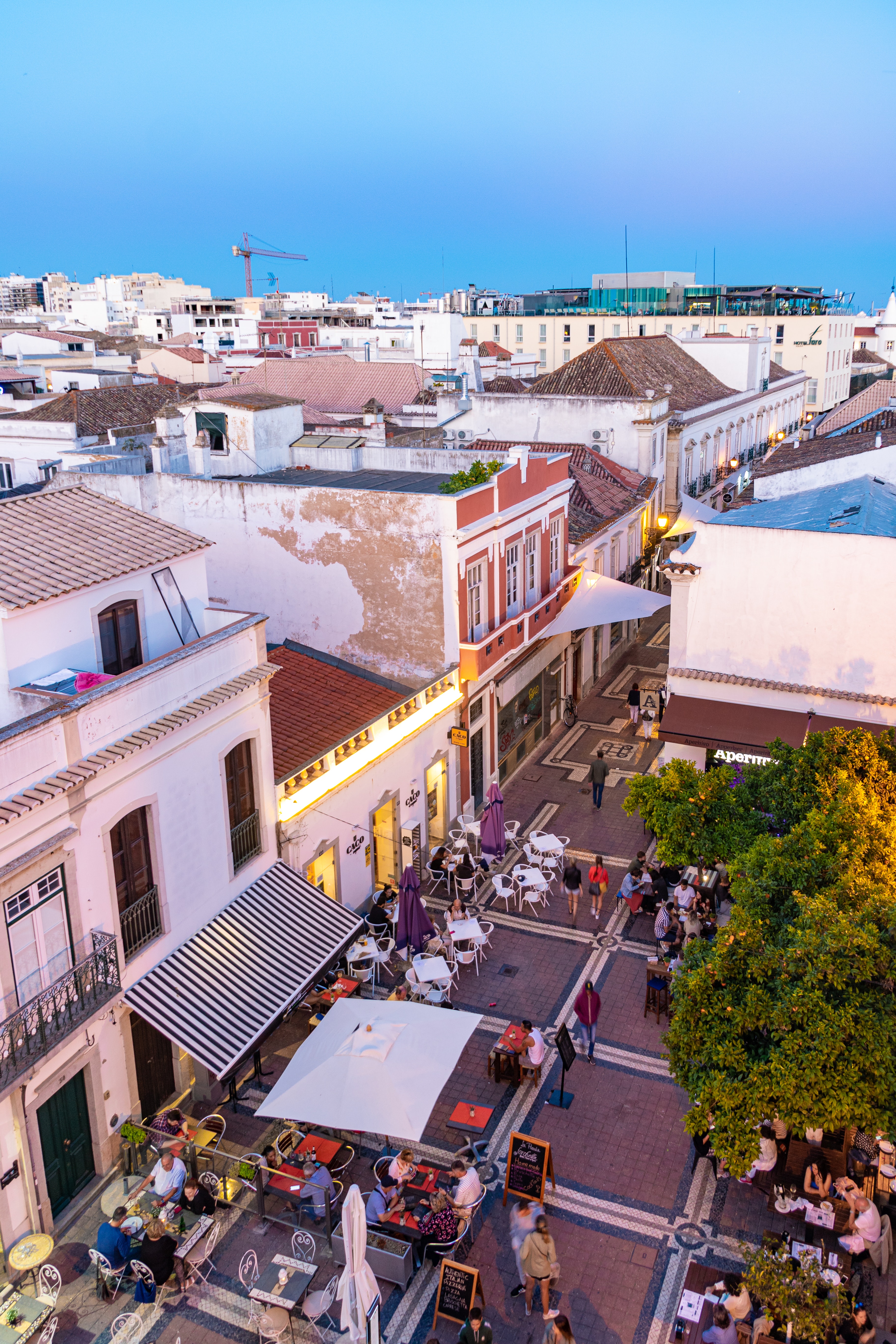
Ukshunubah! Well, Faro. Blame it on the Ossonoba…Photo by Magda Ehlers from Pexels

Obviously, you can’t just throw readers into a mix full of historical world-building with somewhat-informed but often-obscure editorial choices and expect them to sort it entirely for themselves. I created a notes-and-glossary for people reading it; some of the Dear Readers have told me that it is helpful, especially because al-Andalus isn’t a society that most of them have a great deal of specific knowledge about, some of them are not Muslim nor necessarily deeply familiar with Islamic practices so may have some religious/cultural things to wonder about, and some of the events of the story (in particular, the identity of the invaders) are things people don’t necessarily know about and may question: “Did that really happen? Where did you get the idea?”

The answer on that particular question about the invaders (as it’s a good example) is yes: it really happened, the invaders are who you think they are, Dear Reader, and writing about it was largely inspired by reading the passage about the Viking invasion of Ishbiliya in 844 in ibn al-Qutiya, and then seeking out more information about the invasion. ibn al-Qutiya also inspired the initial inciting event: in his chapter about Abd’ ar-Rahman II, he relates a story about a body found in a basket, how the emir* dispatched a visiting Hajji named Muhammed ibn Salim to investigate, how Muhammed ibn Salim found the culprit by tracking down the maker and buyer of the basket, and…the anecdote as written is less than a full page, but it made an impression on me. Essentially, it was detective work that was modern enough to be immediately recognizable as such, and that was fascinating to me. The emir had intended this investigation as a kind of test, a job interview if you will, and Muhammed ibn Salim passed with flying colors. But then, of course, I had to build around that. Muhammed ibn Salim was only mentioned briefly, with minimal detail, so I had to make him a character based on that scanty framework. I changed some details for plot reasons (ibn Salim was likely a provincial minor functionary, not a “jumped-up little Khazar secretary from Baghdad” as he describes himself, the culprits weren’t quite the same, surprise surprise, and I added detail) but that was the basis for the story.

The second anecdote, the one that inspired most of the supernatural shenanigans in the story (not that I needed much encouragement to make it supernatural because I am that cheeseball) was from the attack on the mosque of Ishbiliya (readiest source for readers: there’s a really good recitation of ibn Hayyan’s account up on YouTube, if you’re interested.) The Majus (Vikings) had, in the course of invading Ishbiliya, naturally wanted to burn down the newly-constructed fancy mosque. They attempted it, but were driven back by a glowing, beautiful youth who emerged from the direction of the minbar and fought them ferociously and tirelessly (and evidently freaked them out, because who wouldn’t be freaked out with some glowing dude popping up with a whole can of whoopass labeled “Viking Invader Repellent”); he did this on two subsequent occasions, the end result of which was that they left the mosque mostly unmolested. This account shows up in a couple of sources; theories on the origins of this fabulous and doubtless-apocryphal story have been written by people much better-qualified than I, largely about its mythical purposes. But I am an irresponsible person interested in writing fiction, so you bet I felt obligated to take that story and run with it. I ran a bit further with it than I intended, really, because the characters involved in that took on more life of their own than I had planned.

I do ramble, don’t I? Thank you if you’ve indulged me in this. That rambling gets to one of the problems I must tackle in this: imparting enough information to the reader that they understand what is going on, where it’s happening, and can also get immersed in the world and find it plausible, without having to read me going on at length about Vikings and Portuguese sardines in some blog post or forcing them to read more material.

Obviously, it’s not a bad idea to include a glossary and author’s note in a book, and perhaps even a map (I absolutely flat-out adore maps in books; if there’s a map, I’ll refer to it often while reading.) But I truly want people to get into the story and grasp what’s going on without having to keep checking a glossary the whole time, to suspend their disbelief in the story events without having to fact-check in the Author’s Notes (or beyond), and to not have to have read ibn al-Qutiya and ibn Hayyan (or even a modern work) to have a grasp on the society of al-Andalus. If people Google things and pick up books because they’re really interested and curious, that’s great; if people must Google things constantly, that’s not great, because it shows I haven’t done my job well enough to keep them following me through the story.

InchAllah I get somewhere close to that in making the story itself strong enough to stand on its own merits; I acknowledge there’s a lot of challenge to that because al-Andalus is a society that many readers aren’t going to be familiar with in great depth. But it is my job in this book to flesh that out and make it–or at least my odd version of it–more familiar.

* To answer the “emir/caliph” question, Abd’ ar-Rahman was an emir. The rulers of al-Andalus only became caliphs with Abd’ ar-Rahman III some generations later.

Writing and Self-doubt (Part I)

There are three things that have caused the most self-doubt in me in attempting to write this book: fear that it has no real readership (i.e., market), fear that I will get the history wrong in either small or fundamental ways, and fear that I will wind up writing something that cribs from someone else’s work, or basically repeats something someone else has done. I imagine these are things that pretty much every writer fears, although how much of each afflicts any given writer is probably subjective.

First, readership: I largely started writing this because it was a book I wanted to read, or at least, there were elements I wanted to see in a book that I had not found in combination anywhere, and I wanted to see them put together in a story that was relatively satisfying to me. But just because I want to read a particular book or find particular things interesting and worth exploring in fiction doesn’t mean that anyone else is clamoring for them. The book is a hybrid of genres: historical, mystery, fantasy. You have historical mysteries and historical fantasy as genres, why not all three at once? I mean, certainly, many books tend to have some kind of genre crossover, even genres that are hybrids to start with, but having all three might be a genre too many for some. Then there’s the topic: yes, people like historical fiction/historical mysteries, but the setting is less common and probably less appealing to many. If I were setting this in 9th century Britain, or 16th century Venice, or even just writing the main story from the Viking perspective, it would have greater appeal to a wider audience. I think (heck, I know) that setting any book in an Islamic-majority society, or with main characters who are Muslim, tends to lose a lot of Western readers. That’s a very large topic right there—that you can have Muslims in a story if they fill certain roles or act certain familiar-if-not-always-entirely-accurate tropes out that a large swath of readers are comfortable with, but not other roles—and worthy of its own discussion. Of course, that isn’t the only reason the ideas behind this might not appeal to most readers; maybe it’s too ridiculous, or not handled well, or maybe it’s that my story is really quite tedious. But there it is, and it’s inescapable: either it has broad enough appeal or it hasn’t. In the end, as far as getting it published goes, it doesn’t matter so much if it’s the most brilliantly written, historically accurate, fascinatingly plotted book possible if it isn’t something that people will want to read. That part I can’t control. Thus, just write it and see.

Second, historical accuracy: I fear that I have been writing something that is either riddled with small inaccuracies or has some larger historical flaw in a major premise. Should it be published, most readers are probably not going to notice small issues (and may even question some things that are actually accurate, and I already can guess a few of those), but there may be those readers…and I know this, because I have been one of them on occasion…who really do know the subject better than the writer. I know from experience that inaccuracies can pretty much spoil suspension of disbelief and mess up the story. Granted, there are two things to be said here in my own defense: one, I did a pretty fair amount of diligent research in world-building and fact-checking (for example, in the course of writing this, I have read four journal articles just on Andalusi plumbing, two of which were not in my native tongue) and can at least defend some of my questionable choices; two, unfortunately, there are some things just not known and one sometimes has to make educated guesses and take artistic license. Clothing, for example: there are very few extant garments from al-Andalus, certainly from this period (what we have is fragments of textiles, like tiraz bands); much has to be extrapolated from extant garments from other Muslim areas, or from art or written records. You can do a whole heap of research and still run into questions: here you are, trundling along, and you suddenly have to wonder: “Would people have been eating that? Are they sitting on chairs, or cushions? Yes, but were those perfume notes found in scents of the period? Would she have buttons on her sleeves, and was this color part of the dye palette of the time? How far away from this locale was that neighborhood in the 9th century? How many people fit into that kind of boat?” Sometimes I’d stop and look things up and try not to get sidetracked (fat chance); sometimes I’d recognize that sidetracking was far too likely, or that the answer wasn’t simple or readily found, or there were conflicting accounts…and I’d mark it as something to backfill later. Sometimes the answers just weren’t there, and sometimes if you don’t just keep writing you won’t write. On one or two occasions, I picked something that was possible even if not the most probable because it fit the story better (I tried not to do this at all, but I did create one character whose origins are improbable although not impossible.) I worry that someone will spot a particularly obnoxious, egregious, or utterly impossible flaw in the history, and it will be an utter disappointment to that person; I’ll get wind of their disappointment and possible scorn and feel very bad about it (getting ahead of myself in assuming it gets published and actually reaches the reading list of someone likely to feel disappointment and scorn in my historical flaws.) I made a lot of historical corrections as I went along and learned new things. It’s probably still error-riddled. At some point, I had to stop dithering and pulling out books and articles and just write.

Third, unintentionally plagiarizing/writing something someone else has done/doing something too similar to another writer’s work or that appears really derivative: this one terrifies me. As I said, I started writing a book based on what I wanted to read about and couldn’t find. I didn’t think this particular story had been told from these particular angles. In fact, finding anything written about this particular set of historical events was rare. And then as I was writing, the doubt started creeping in: well, Gaiman has done a lot of exploration of the nature of old gods no longer worshiped…could this wind up too American Godsish in theme, or like some arcs in Sandman? The only fiction I’m finding about al-Andalus seems to be written about the end of the era, about later in the era, or as part of the “clash of civilizations” (and mostly told from the Christian-Iberian POV), or is otherwise not like this…but is that all there is? I’m afraid that much of what is written by non-Muslim American and UK writers exploring Muslim culture of the period doesn’t feel authentic to me, however well-written it is otherwise; it feels as if they’re writing about something that they’re not really culturally comfortable/familiar with and they are sometimes over-relying on predictable tropes. I recognize that as a sweeping judgment, but I often do sense discomfort in authors uncertain of how to write these characters. Spanish writers have done much more with the era, which makes sense, and have a different mode of approach. I have to confess that my Spanish is now kind of rusty, and reading in Spanish takes about 3 times as long for me as English (my French is starting to get out of practice, too.) Am I rewriting someone else’s work unknowingly, only in English? Finding out what was out there in the first place was important, which meant exploring Spanish books in particular. Ah, look, Carlos Aurensanz wrote a trilogy of novels about the Banu Qasi; I’d better read at least the first one, since Musa ibn Musa shows up in my book, and it’s good to see what other writers have done with the period…all right; I’m not unintentionally treading all over Sr. Aurensanz’s work. Oh, and here’s Mario Villen Lucena’s 40 Dias de Fuego, about the Viking attack on Ishbiliya…ah, mierda, in the first chapter we are introduced to an Amazigh shepherd, uh-oh…O.K., whew, totally different book (warning: although it’s quite good, there’s a lot of graphic violence including depictions of sexual violence, which I tend to skip over when reading.) Back in the anglophone world, G. Willow Wilson has written a book set in al-Andalus featuring djinn. Oh, dear, I really like her stuff and I hope it’s not too similar in theme…well, it’s set at the fall of Granada. I will read it when I’ve finished writing this book (I’m reading and enjoying it now, matter of fact.) I don’t write in a particularly similar style, I think, and I’m clearly not being derivative of her. And so on. You get the gist. I could spend all of my time slowly reading Spanish novels and fretting about possibly surveying ground already mapped, or I could call it good and just write my book.

That’s many words I’ve written, all about the forces standing against me that happen to be in my own head when I have contemplated actually sitting down and writing a work of fiction that is set in a particular time and place, and has particular sorts of characters. Always there is the obnoxiously persistent voice, oily and overfamiliar, murmuring into my ear: How are you qualified to write about this in the first place? Why do you presume to do this?

Well, I probably am not “qualified.” And I might not have historical accuracy so flawless it stands as a masterwork of scholarship, at least regarding Andalusi indoor toilets*. I might not have a surefire bestseller which has themes that everyone can relate to and wants to read. I might wear too many inspirations on my sleeves, or be writing about events that other (better) writers have written books about. But regardless, I have just had to set all of that aside and say to the obnoxious voice, every time it pipes up: At least I’m actually writing it.

*These existed, yes, and there is evidence that they were ubiquitous: archaeological finds suggest that even poor homes in the city of Qurtuba had indoor plumbing. If you are time traveling and looking for a period that won’t be too difficult if you like hygiene and plumbing, al-Andalus is a good choice.

Reading list: al-Andalus

Someone asked me not long ago for books to read that I’ve used for research. Which sounds unwarrantedly pretentious, as an unpublished writer. But here’s the thing: I’ve done a fair amount of research, simply because I’m keen on the topic, and someone asked and I really need little encouragement to share. So to that end, here is a (likely to be expanded) list of books I’ve found helpful and interesting. I also have a Goodreads shelf of books, which includes fiction (some good, some so-so, some really good.) Some of these are about later periods, but even those are often very useful. My last job gave me unfettered access to its academic library (losing that access is one of the few regrets I had in leaving), so I also have used and consumed an…unusually high…number of academic articles, as well. There is so much that can be found with more-public access as well, like academia.edu and JSTOR, so do check them. But the following is a list of books I would recommend, from the introductory to the really specific.

The Tibyan: Memoirs of Abd Allah B. Buluggin, Last Zirid Amir of Granada: 11th century, but not only is it fascinating, it’s a pretty unique glimpse into the life and mind of a dethroned ruler near the end of his life. In writing royal characters, that insight is really helpful. This book, if you can find a copy, is very expensive. The academic library I had access to at my last job owned a copy, and I kept it out for as many renewals as I was allowed (2 or 3; I didn’t hog it.)

The History of ibn al-Qutiya (David James, ed.): 10th century. This one, fortunately, comes in an affordable edition. Two of the stories he relates inspired me to start this book (I’m not blaming him, mind; it’s really my own damn fault I wrote this.) I highly recommend it.

Kingdoms of Faith, Brian Catlos: A newer book, and a very good, readable history. Actually, this is my favorite general history.

Moorish Spain, David Fletcher: A classic work.

Revisiting Al-Andalus: Perspectives on the Material Culture of Islamic Iberia and Beyond, Glaire D. Anderson and Mariam Rosser-Owen: If you want to know (based on archaeological evidence) what al-Andalus looked like and how its people lived, this is essential reading. This book is one of my favorites, and one I used the most in trying to put together the world of the book. Warning, though: it is academic in nature, and not necessarily thrilling reading for people who just want the highlights.

A Vanished World: Medieval Spain’s Golden Age of Enlightenment, Christopher Lowney: Written more for a popular audience than an academic one, and quite good.

Granada: A Pomegranate in the Hand of God, Steven Nightingale: another less-academic work, also quite good as background reading, rather than more specific work.

The Ornament of the World: How Muslims, Jews, and Christians Created a Culture of Tolerance in Medieval Spain, Maria Rosa Menocal: Another popular work, and one that for some reason makes some people rather cranky (the scholarly quibbles are one thing, but much of the crankiness is actually unpleasantly ideological, so fie on that), but it’s a lovely book and a very good introductory read.

Defining Boundaries in al-Andalus: Muslims, Christians, and Jews in Islamic Iberia, Janina M. Safran: Exactly what it says on the tin. More academic. I think it’s a pretty essential read, though.

Conquerors, Brides, and Concubines: Interfaith Relations and Social Power in Medieval Iberia, Simon Barton: I read this when I was already beginning to edit my first draft; it’s an enjoyable if sometimes dense read.

Al-Andalus, Sepharad and Medieval Iberia: Cultural Contact and Diffusion, Ivy A. Corfis: Definitely more academic than accessible, and is occasionally quite esoteric. The topics range pretty widely, which makes for a more comprehensive volume. Worth reading.

Daily Life in the Medieval Islamic World, James E. Lindsay: Not Andalusi-specific, and I found it personally less useful than some of the other books I’ve listed, but a really good book to have on hand as reference if you’re going to write about the period.

A Descriptive and Comparative Grammar of Andalusi Arabic, Institute of Islamic Studies of the University of Zaragoza: I really lucked out in getting a copy of this, because like the Tibyan, it’s usually pretty dear. And maybe most people wouldn’t need this, but I’m ridiculously over the top about linguistic stuff, and I do love a good bit of wordplay however esoteric (I make a linguistic joke in the book that is possibly unforgivable and an editor would probably cut it.) I believe that understanding how people use language gives me insight into them as people. Hence I am including it on the list.

So that’s a list of books I’ve used and recommend, most of which I have copies of on my desk (or in my Kindle, in a few cases.) I’ve left off a good half-a-dozen that I will come back to and add, and there are books about later periods that are also really good reads for a broader scope of knowledge that I may also add to the list. And books about djinn, because I know people are keen on that bit.

On the naming of things and people in books…at least my own.

One of the things that I find quite challenging in writing is choosing names. As a confession, the book in progress—and it’s in the throes of its final edits before I attempt submission now, mind—still has no name. I have titled the manuscript Those Without Voices, which may or may not be what I keep it as. Most likely it will not remain so, because I’m beginning to dislike it. I harbor grave doubts about my ability to name anything well, much less a book. Because I know my limitations, I simply labeled the file “Pomegranate” when I started writing it. No particular reason, except that I like both the fruit and the word, and it grows in southern Iberia. “Pomegranate” it remained almost entirely through its first 126,000-word draft. Eventually it became “The Voiceless Ones,” but that was less than optimal. Each iteration is smaller on the word count, too, as it should be.

The “voiceless” phrasing has to do with an Andalusi convention whereby it was common to call certain foreigners “voiceless” or “dumb ones”—i.e. they did not speak proper language. I’m not in love with the name; it works in the original but sounds a bit mawkish as a title in English. I hope I change it.

My first completed book manuscript was entitled A Bird in Exile, which is pretty phrasing, but in many ways did not fit it (I sometimes cringe when I think of that book; even though it was not poorly written, the plot was trite. Ultimately, it’s probably better that it found no publisher. “Do the best you can until you know better. Then do better.”) I can’t take credit for that pretty phrasing, though; it was from a line of Rumi. Which, in and of itself, is dangerous, as Rumi (or things that Rumi allegedly wrote but frequently did not, or “translations/interpretations” of his work that frequently bear little resemblance to the phrasing and meaning of the originals) has been overused as a font of rather commodified inspiration in a way that is sad to my inadequate Sufi heart.

Then there are the names of characters, which has been (and has always been) something of an effort. When one is writing historical fiction, there is a bit less latitude; the names have to be historically and culturally plausible. Writing a book set in al-Andalus in the 9th century gives one fairly narrow parameters for naming a given character, which should make it more straightforward, but it also gives one more opportunity to pick the wrong name. Why? Diversity.

Something that makes me impatient with much of the common understanding of al-Andalus is the highly limited narrative of it as a land of “Moors vs. Christians.” Which, beyond any acknowledgment of the way those lines blurred, completely dismisses the existence of Sephardic Jews, who were an integral and very influential part of Andalusi society from the very beginning right up until the bitter end. The erasure of Jews in that narrative was not accidental, and it would be good for people to challenge themselves on it when they reflexively break it down to “Moors and Christians.” It was a strikingly diverse society, and this was by no means a new thing: the Iberian Peninsula has seen waves of immigration and colonizing from very early times, from Greeks and Phoenicians to Celts and Carthaginians, Romans, Alans, Suebi, Visigoths. I would point out once more that Iberia had a significant Jewish population early, as well. Then there were the Tartessians, whose origins no one is exactly certain of (they may have been indigenous), although they were probably not aliens (there is an unfortunate line of modern occultist thought that this was the case. You should not be surprised.) On the other hand, they held their mythical progenitor to be Geryon, who had either several heads or extra limbs, so that’s not completely off the table. I digress; needless to say the Iberian Peninsula had seen the comings and goings (and stayings) of many peoples. This is not an exhaustive list, either.

All this, poured into a land of Iberians and Basques (Basques of course antedate everyone.) Add to this mixture the arrival in the 8th century of Arabs (who had their own subcultural group differences), Imazighen, African peoples from south of the Sahara to the north and east, and then people like the Saqaliba, Eastern Europeans brought in largely by the slave trade. Throw in less-repellent forms of trade and you have even more people coming in from even further-flung areas, because al-Andalus was pretty cosmopolitan despite getting sneered at as the backwater of the Islamic world, and it gets even more complex. Then again, Christian Iberians were hardly a monolithic collective; there was a cultural divide among Visigoths and the greater Celt-Iberian and longer-assimilated population, even in their Christianity. The Visigoths, who came in from central Europe as clients during the Roman period and filled the power vacuum after the Romans, converted to Christianity early—but their Christianity initially was Arianism, unlike most of the other Christians of Iberia, until the Visigoths changed course on Arianism in 589 with the Council of Toledo. ‘Twas the Visigoths (again, not an indigenous group; they were colonizers, too) who were in power when Tariq ibn Ziyad sallied forth and began the Umayyad conquest of Iberia.

Even among the people lumped together as Muslim “Moors” (n.b.: this word really isn’t a thing), Imazighen are not Arabs, even when Arabized, and even their take on Islam had some differences due to inherent cultural differences and social factors. Furthermore, there were the muwalladun, the people who converted. I could break it down further, but understand that each group had their own cultural context. Inherent cultural differences inform people’s choices, even (especially) in a pluralistic society, even with assimilation and cultural exchange and colonization.

So what has that to do with naming characters? Ah, see, there is a point to my rambling. That point being that it isn’t enough to pick “Muslim” names and early Spanish “Christian” names, because all of those various peoples had different names and naming conventions, and every group added something to the giant Iberian pot as they assimilated.

I knew better than to give everyone names in Arabic or Spanish to show the difference, because that’s the lazy dichotomy, and it’s not historically or culturally accurate. Half of the characters I use were real people, anyway, so I had fewer names to worry about; those characters had ready-made names of their own. But despite all of my reading and research, despite knowing the various ways that names in Arabic, for example, are put together, I often found myself drawing a blank when having to name a character. Far too often, as a placeholder, I’d give someone the first random name that popped in that was moderately appropriate. I’d change it later, I told myself. The net effect was that I had people with decent Arabic names (although I had to check frequently to make sure I wasn’t repeating or giving characters names that were too similar), and some with decent Amazigh names, and…well, heck, what were the Spaniards going to be? Who were they going to be?

There are lists of names found in old documents—al-Andalus was a society with a strong sense of the power of the written word, and a tendency for robust administration and record-keeping, fortunately; some of that even survived the zealous destruction of records and books after the fall of Granada—and seeing the lists reminds you of how very diverse the society was. Here are Visigothic names, which look distinctly Central European; here are names that are Hispanicized Arabic or Amazigh; here are names that are clearly Roman Latin evolving into Spanish and Portuguese (and languages like Catalan.) Some were very Roman, some almost anachronistic in how Spanish they appear. And over here, these are the Basque names, which no one else would have, but which Basques certainly would. Don’t forget that slaves were frequently given Arabic names that were diminutive, descriptive, or words for objects. I have one enslaved character who retains his original cultural name; that was a very deliberate choice, as it said something about the character of the person he served. This character is also an oblique nod to Bedr, the formidable Greek freedman of Abd ar’Rahman I, if not in naming convention.

For a while, many of the “placeholder” names I grabbed were Visigothic and few were appropriate, as few of the characters themselves were of Visigothic heritage. I confess that I was being lazy. I went back and devisigothified several names in the second run-through. I gave a character a soldier’s nickname, with the intent of introducing a backstory (I keep most character’s backstories in my head, from brief sketches to a full biography), and then realized that was not going to happen, and the name looked silly and wrong without that. So off I went to find a name appropriate for an aging soldier of Romanized Iberian family; I settled on one that had the same kind of rhythm as the nickname, and is completely in keeping with the character.

I had to change names for other reasons: a relatively minor character had a name that reads similar enough to a more major character’s name to cause confusion for two beta readers, so that had to be changed. And so on. As an aside, in that pretentiously-titled “Fragment” I posted a while back, two of the characters have since been renamed (of note also: I recognized that the formation of plurals in the Basque language does not use an “s” and am assuming that extends to earlier forms of the language; thus iainkoak, not iainkos. It still may not be correct, but I’ve done some due diligence in order to use that one word, which I honestly felt was important in context. If any Euskadi speakers correct me, I’d welcome it.)

What of the djinn in the book? Once again, I treated them as a diverse population, as they would be: some are native in their affinities and origin, some Roman or Romanized, some Muslim. Therefore, they got names that reflected that, although only a few are “real” as in human names; most are not quite human names, but they still had to reflect the particular djinn’s heritage (well, cultural affinity), so they’re mostly adaptations of human names from those cultures. I suppose I could have created entirely new, alien, djinn names, but these are the ones that took…and recall I am not good at naming, so if I’d created unique “djinn language” names, they would have probably been really silly.

I struggle with names, both remembering them and choosing apt ones, but I think the names for characters in this book now make sense. Mostly. Still, a risk in writing history is having a broken or inadequate understanding of the cultural mores and nuances, and I’ve possibly picked a wholly inappropriate name here or there. On the whole, though, I am satisfied and feel at the least I can defend my naming choices with some coherence.

I would still like to come up with a really bang-up name for the book, yes.