
The Memory of an Orange

This is my orange tree. Sprouted from a seed in 2017, he has grown to almost 5 rather leggy, awkward feet; he has stubbornly refused to make many branches, preferring to exert his energies into becoming one tall, spindly leafy stalk with two or three small branchlets like afterthoughts—and never where he was pruned, as all advice meant to coax him into making branches assured me would happen. As he sits in a very large pot on my front porch, I have had to explain to visitors what “that funny-looking tall plant” is. A month or so ago, however, I discovered that he’s decided to go in a different and exciting direction with his art, branching out at every node. And now he is starting to look like a tree. He’s not the glamorous bushy creature that my lime has become (I rescued that from the curb, where someone had left it after an unusual frost had battered it; it has rewarded me for not giving up on it by being quite a pretty lime.) He’s really kind of a punk.

Punk orange tree, with lovely new green leaves.

This stubborn cuss of a plant is a Citrus aurantium, the bitter or sour orange, also known as the Seville orange, the ur-orange of the modern fruit found in your local grocery store. DNA studies indicate that the species originated in the foothills of the Himalayas and spread thence westward. The sour orange reached Europe via the Umayyads; it is said that Ziryab himself, 9th-century musical prodigy and influencer before influencers were a thing, introduced the convention of orange juice for breakfast (that may be anecdotal, but someone had to do it, after all.) The oranges get mentioned more than once in my book, because the oranges represent something fundamental in the heart and soul of al-Andalus.

…And, also, I am enamored of the sour orange. Web pages will caution you that they aren’t really good for eating (except in marmalade, say), but I know that not to be true. To take a bite of one may be a rude surprise to one expecting the sweetness of the Valencia, navel, or blood orange, but they have a depth and dimension to their sour assertiveness that, frankly, I love; I know other people who feel the same. Their skin is very firm and thick; they aren’t easy to peel. The fruit itself is heavily fragrant—in fact, the sour orange is commonly used in perfumery: the honeyed-light sweetness of the flowers with an undercurrent of decay makes orange blossom absolute; the sharp, assertive, woody green citrus of the leaves and stems make petitgrain; then there is the oil from the fruit itself, a burst of sweet, sharp, and juicy. When you peel one of these oranges, it’s important to really dig your nails into the rind to savor the lovely oil scent, so thick and heady it’s like rhythm.

Orange blossoms are one of the best smells in the world, and I will see no debate on that. Paradise is perfumed with orange blossom, in my conception of it.

My tree was grown from a seed taken from a rather special tree. His progenitor lives on Sapelo Island, untended and mostly noted by visitors as a pretty novelty; as I mentioned, the fruit are not to most people’s taste, and tourists who pick the lovely fruit hoping for a sweet snack are usually disappointed (although the Gullah Geechee of Sapelo do use the sour-orange juice as a home remedy for coughs and colds; it’s mixed with honey, and, according to one of my friends, alcohol is usually involved.) There are five or six such feral sour-orange trees on Sapelo that I know of; this one is near the mansion, and by all rights should not be as impressive a tree as he is. He grows at the very foot of an ancient live oak tree; despite this formidable competition for resources, this orange tree is about 25 feet tall and not young. Every year, he scents the surrounding air with the benediction of his flowers and produces a beautiful crop of bright fruits. He’s a very hardy tree, having weathered numerous hurricane-and-tropical-storm seasons, half-hidden by the oak and not paid much mind except by the occasional strange person like me; I visited this tree regularly when I worked on the island (Hurricane Irma sent the island over a foot of storm surge; everything green suffered a bit from the inundation. He looked somewhat sad and drawn in on himself, so I took a bag of citrus fertilizer out there to him. I think it helped. Maybe.) Seville oranges are known for being tough and sturdy; they are often used as rootstock for sweet varieties for that reason (with age, the sweet oranges will “revert” to the rootstock; the oranges of such an aging tree are a bit dismaying. They taste like they should be sweet and they have the sweet-orange texture, but the flavor is bitter and chaotic, not sour and well-composed like that of a true Seville.)
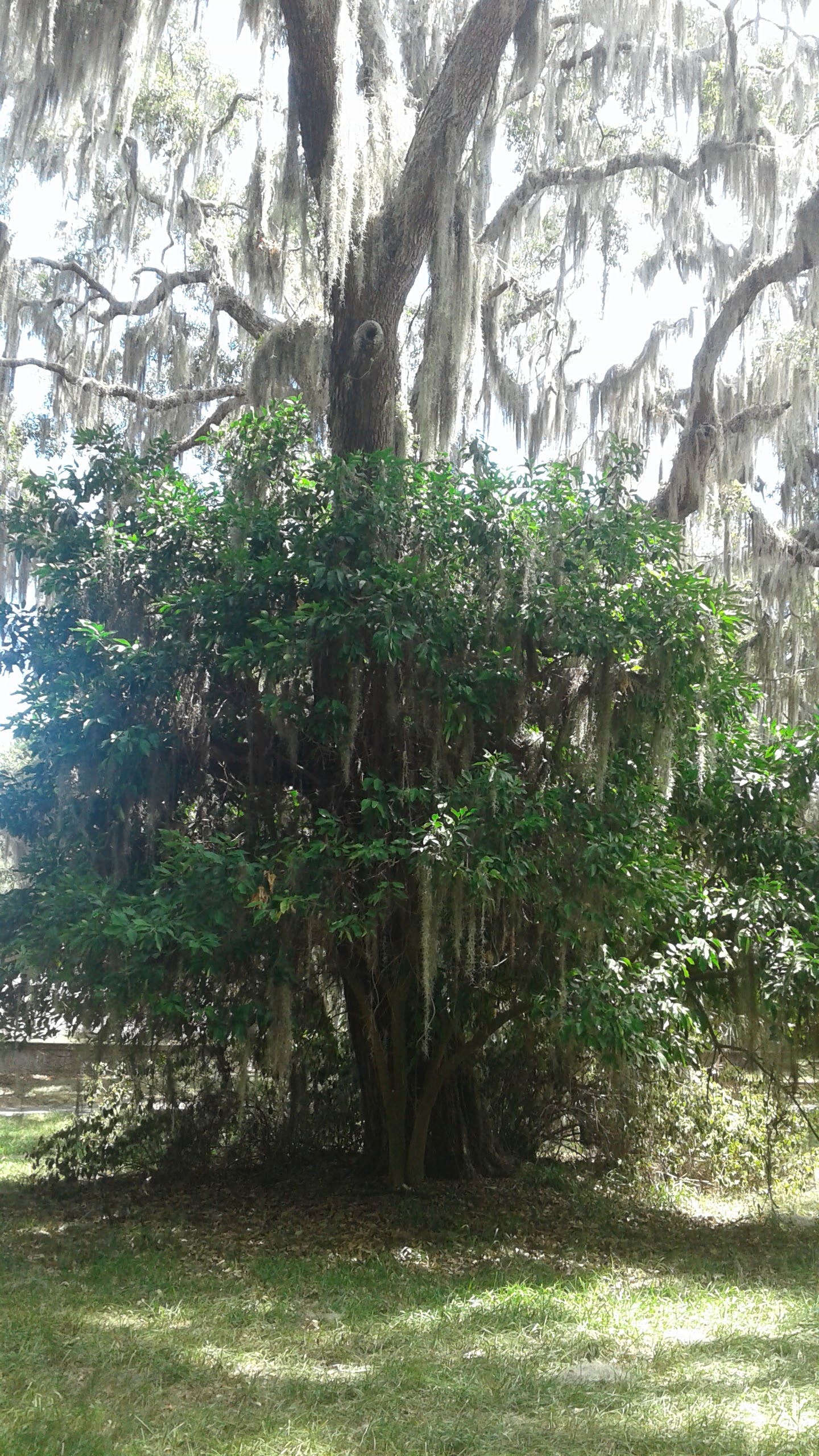
The parental tree. It’s hard to see the scale here, but he’s about 25-30 ft tall.
The live oak behind him is massive.

So what’s with the presence of feral Seville oranges on Sapelo, and elsewhere dotting the landscapes of Florida and coastal Georgia? The answer, of course, is the Spanish. The territory of La Florida comprised northern Florida and coastal Georgia in the 16th to 18th centuries. In the latter part of that era, coastal Georgia was “the Debatable Land,” with the English making inroads and the Spanish snatching back. The Spanish loved their oranges; there were even attempts to grow wheat and oranges as cash crops (see here for one discussion of this.) Sapelo was the site of one of the mission settlements that ranged along the coast of La Florida.
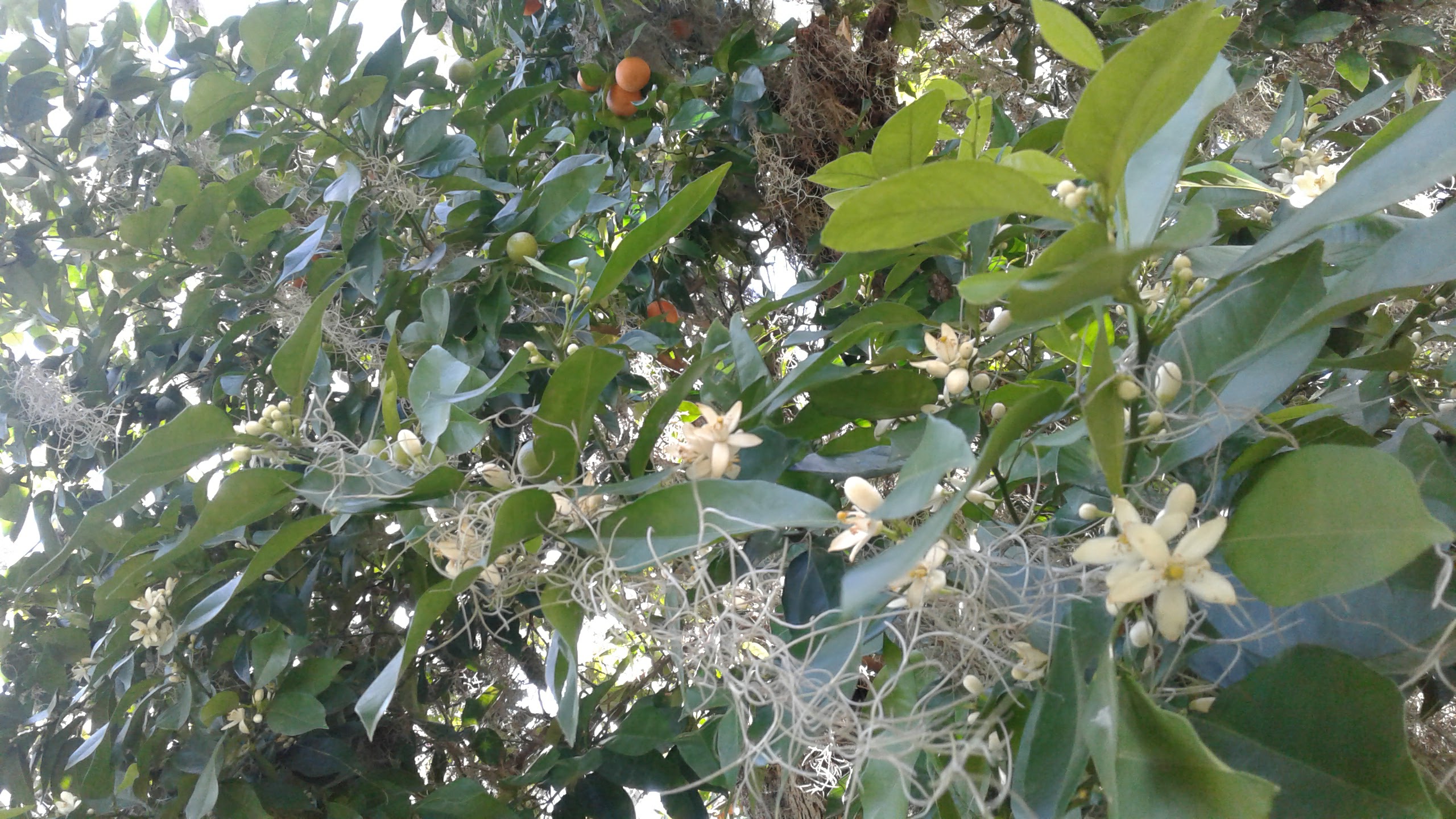
Parent tree in flower and fruit.

There were several such missions built during the late 16th-early 17th century period; the Mission de San Joseph de Zapala was in full use by about 1610, but I think it was started in 1594 (don’t hold me to that exact year; I’m too preoccupied right now to confirm it.) The Spanish moved in on the territory of the Guale people, who were already in the midst of a shakeup due to an epidemic and attacks by the Westo, a far-ranging tribe who had adopted a practice of capturing slaves from among southeastern peoples. The Guale had a settlement on Sapelo; the Spanish shouldered in and built their mission. Somewhat later, a group of Yamassee, who were likely refugees, moved onto the island as well. The Spanish interaction with the people of La Florida was always thorny (to put it mildly): Spanish exploration was explicitly “for cross and crown”; they were looking for riches and converts. Their view of the native people was not a good one; recall that this was the time of “limpieza de sangre” (purity of blood), a policy that viewed anyone with the “stain” of Muslim or Jewish blood as markedly inferior to “cristianos viejos”; I contend this ideology was a foundational template for modern white supremacy. Imagine how those who held that idea extended it towards indigenous Americans. True, there were those, especially among the Franciscans, who took a more benevolent stance, and people who have to live together at a small scale tend to learn to get along. Somewhat. But the Spaniards had their own agenda, which really wasn’t about seeing the people they encountered as equals.

Needless to say, the missions did have problems with uprisings from both the Guale and Yamassee (having read detailed accounts, I cannot say I blame them at all for rising up.) Furthermore, the missions were facing increasing incursions from the English, the English-backed (and armed) Westo, and French pirates. Over time, the mainland missions were closed and everyone therein moved to the island missions; eventually, all of the missions were consolidated onto Sapelo, as it was a defensible island. For a while. The Spanish eventually packed up in 1684. They did return in 1686 to drive off a settlement of Yamassee who’d remained near the old priest’s house (why did they drive them off? Spite?), and destroyed the remains of the mission and settlement. Including the groves of orange trees. The Englishman Capt. Dunlop, in his “Voyage to the Southward,” wrote of what he saw in 1687:

“Moving early we came about noon to Sapale…where we see the ruins of houses burned by the Spaniards themselves. We see the Vestiges of a ffort; many great Orange Trees cut down by the Spaniards in septr last…but all had been burned to Ashes last harvest by themselves…”

One can destroy a grove of fully grown trees, but there are always seeds.

These random feral sour oranges on the island are not the very trees a Yamassee or Spaniard picked fruit from, mind, as oranges don’t usually live to be 400 years old (there are rare examples of very old sour orange trees, but those have been cared for conscientiously for many years; it must be a remarkable burden to have to be mindful of one’s stewardship of an ancient living thing.) These were likely rooted from a seed dropped by a bird at the foot of a live oak, or a fruit eaten by an animal and then excreted. They are all tough cusses, living out their lives mostly ignored in a mostly wild landscape, each year offering the dazzling sweetness of their blossoms to the air and the bees, their perfumed and rough-skinned sour fruit to any creature who will eat them.

I am fascinated by the concept of epigenetic memory: that what an organism’s ancestors lived through survives in and alters its genetic patterns; it’s a more empirical (and therefore more respectable to those who may scorn the “fuzzier” concepts) form of ancestral memory. Like the dog or Bombyx mori, the orange tree is a species cultivated by humans. We have altered it on the genetic level so that it has adapted to us; therefore, I’m sure we are part of its epigenetic memory. Like the dog and the silkworm moth, then, it has an existence that is not ours and is apart from us, but it must on some level always be aware of us, the species that has etched our collective name in its DNA. I imagine these trees collecting and cataloging their memories of all of the people who have lived on the island–the generations of Gullah Geechee families, the rich men of the mansion, the doomed 18th-century French entrepreneurs, the Guale and Yamassee people, Captain Dunlop, the Spanish soldiers and priests. I imagine their roots holding the memory of the sunwarmed and well-watered soil of a garden in al-Andalus, or of being a dreaming seed carried westward in a pouch or pack along the Silk Road. It may be fanciful and even twee of me to say that, but on some level we all acknowledge the potential sentience of trees: there is a reason we all understand the concept of witness trees, trees which were present during a significant event in a significant place, and have survived long years since. These trees are landmarks in and of themselves, and we may touch the bark of a tree which was present at a particular time and wonder what it experienced and what it remembers.

My young tree unfurls his tender new leaves to the sun, having stretched himself out to what he deems a currently satisfactory height, no longer such a “funny-looking plant.” There are at least 3 other such young trees sprouted by me from seeds from that sturdy tree (one of the most sentient trees I’ve ever seen) and given to other people. They’re doing well. My tree hasn’t made blossoms and fruit yet, but I have a suspicion that will be coming soon. He’s flourishing, and I may have to get him an even bigger pot (at this rate, it’s going to have to be some massive vat soon; I’m living in a rental and I refuse to put him into the ground here.) He’s already got a very big pot and he seems quite content right now to grow and hold fast to whatever memories his family holds.
And now for something completely different…

I’ve been thinking about writing this for a while, and while it’s not so much about writing, it does have some history tie-ins. It’s political. I will go somewhere with this, I swear. I think. And it may be a two-parter.

In 2018, someone I’d known some years ago and had kept some social media contact with responded to one of my Facebook posts (which was a link about voter purges in Georgia) with a bizarre comment in all caps: “NO ILLEGALS OR DEAD TO VOTE” complete with a link to some dodgy video on an off-brand site. The person in question had always been this kind of love-and-light hippie (not entirely unproblematic, but basically benign), so I was puzzled enough to check the link. It was a bizarre rant about “illegal refugees” in a “UN-planned invasion” pouring into the country, spreading horror in their wake. Now, these particular people were also apparently time travelers, as they were bringing in smallpox and leprosy (I am not making that up.) Possibly King’s evil and an ague or two as well. Pause for a beat to contemplate that. I was aghast, disgusted, and bemused, in that WTAF kind of way: did she not know how to…read the room? Why would she think I would be at all receptive to this ludicrous, hateful, xenophobic, racist garbage? How did she think I would react to the demonization of oppressed people desperately trying to survive—people with whom I have much more common ground than someone like her?

Naturally, I dropped all contact with her because when someone goes from pleasant vague acquaintance to “what is wrong with you?” in a twinkling that’s what you do, but did check out what was unfolding on her page, and this was my first experience of the movement…known by a certain alphabet letter. There was all this horrifying conspiratorial mess, served up with the most rabidly racist, antisemitic, Islamophobic, xenophobic, and frankly bat-guano bizarre commentary. I check on her social media from time to time; her latest obsession is very trans- and homophobic. Post after post of it. I wonder how many of her former acquaintances and friends from marginalized groups now feel betrayed: so this is what you really think of us? Have you always thought this? (To clarify, and this is very important; I’m putting it in bold so people will not try to assume this is negotiable with me: I am not down with either homophobia or transphobia. Ever. I’ve angsted over how to present historical LGBTQ+ issues in my writing without suggesting I promote marginalizing anyone, even casually—this is especially so because I’m Muslim, and I strongly believe we collectively need to clean our house on that, especially because it wasn’t historically and culturally always the case. I’ve had friends read for that where I’ve touched on it, which doesn’t mean I’m home-free. Anyone can mess up, however unintentionally, and even unintentional needs to be addressed. It’s my responsibility to own that; the same goes for antisemitism and anti-black racism in my community.)

I framed her “conversion” as a strange volte-face, but I don’t think this is true. I suspect a lot of the previously expressed allyship was convenience. I know that we’re seeing a lot of masks dropped with this. “This isn’t you, is it?” Sadly, it IS them. It is who they are, and it is their responsibility. I’ve lost a few friends in the past few years over politics and realizing they weren’t who I thought they were, some of which losses cut much more deeply than this acquaintance’s did. But it was my first experience of this nascent cult.

My second experience involved a couple in my neighborhood who owned a cute little shop and who’d always been kind and friendly. They got gradually more distant to everyone—not socializing, not stopping to converse, and then one day the signs went up in the windows of their store: carefully crafted and cryptic, one just featuring…that letter of the alphabet. They soon sold their store and moved away. Everyone noticed how sad they seemed; I certainly did. I still worry about them, even while abhorring what they have bought into and what it says of them.

I think about the sadness, the shrieking, the anger: that movement seems to produce no joy. At most, there seems to be a kind of shrill, righteous glee, a spurious kind of triumph. Which is one of the reasons I think that ultimately this, like many such kind of radical fringe movements, will fail (iA): it offers its followers nothing tangibly positive. It destroys, but does not build up. It offers nothing in return.

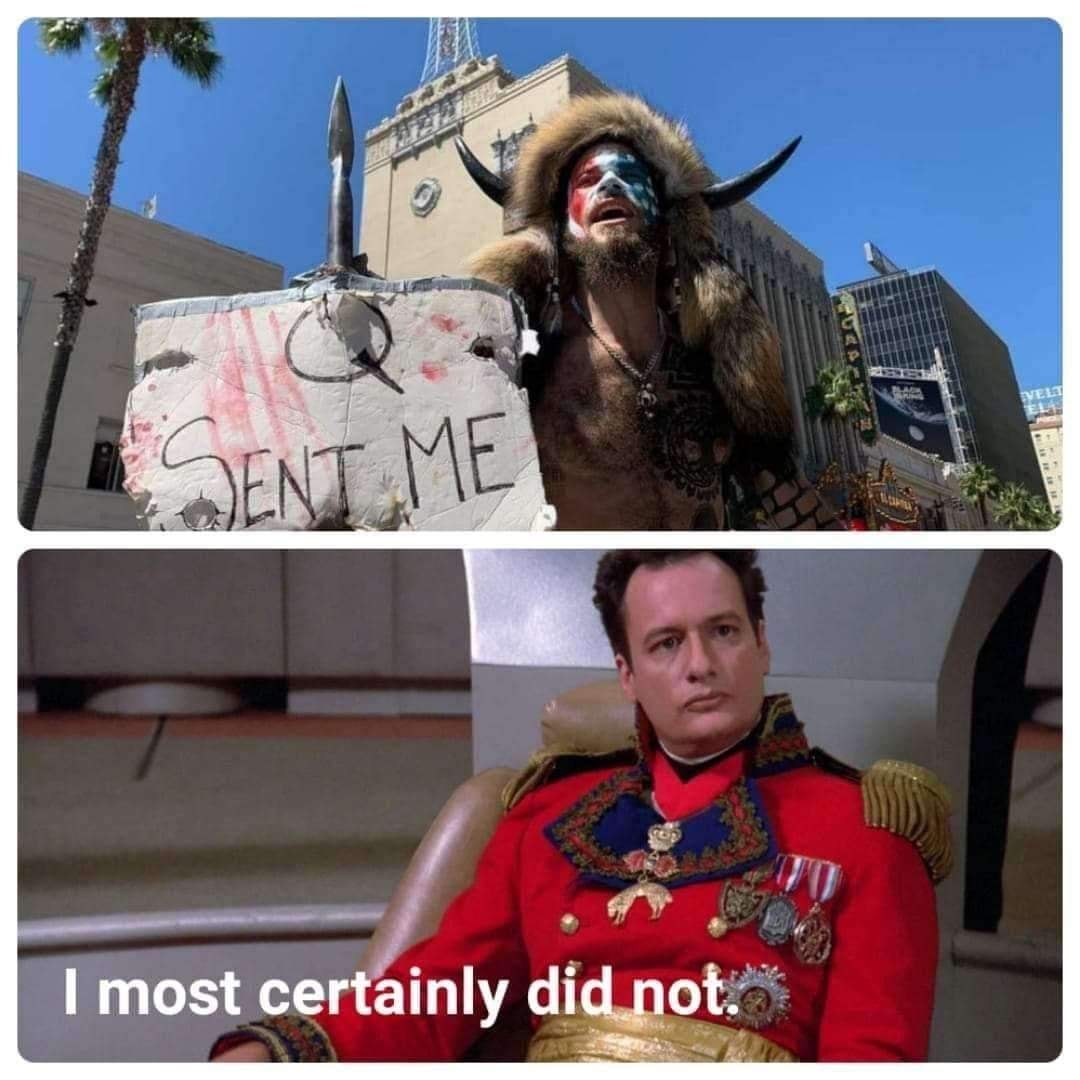
Did not! Did not!
The only time I will refer to this group by name: in a shared meme highlighting the absurdity.

I have read a fair amount about fundamentalist and extremist movements through history, and these are just some very scanty thoughts on how this fits with them. One of the things that I’ve seen discussed by many writers is that these movements rely on revisionist narratives (Karen Armstrong in particular discusses this in a way I found very accessible): that brand of fundamentalism/extremism is reactionary; it frames itself as a return to the past as a reaction to the “evils” of modernity, when really the “roots” it’s trying to claim are mostly wishful thinking. It’s reactionary and revisionist, claiming faithfulness to an “ideal” past that did not exist.  It requires the creation of a narrative of a kind of purity, and a narrative of an “evil” to rail against. In these things, this particular movement is typical, with its focus on a “return” to the “good old days,” and its creation of bogeymen. In all of this, the movement at hand is rather typical.

However, here’s where it goes off-script, even while it tries to adhere to the script: to be compelling, the narrative that accompanies these movements has to have some roots in legitimate grievance, the corruption of the elite being the most common. For people living in a state where a very rigidly stratified inequality exists, this is going to resonate. Hence many of these movements find traction as populist movements, and a following among those who are marginalized. The vision they offer of bettering oneself is presented as a kind of meritocracy, usually spiritual: instead of having people who are at the top because of wealth and family, one flourishes due to the merits of one’s soul, as expressed by how pious one is, how “pure” one’s faith and behavior is. It is therefore theoretically attainable for anyone to be “better”: just be good enough, for x value of good. There is no accident of birth involved, or acquisition of money. There is usually a denial of the material, in the form of asceticism (think of ibn Tumart’s Almohads, or Savonarola’s Piagnonis.) There may be a carefully-crafted narrative giving these leaders a particular legitimacy to lead (ibn Tumart presented himself with a genealogy of descent from the Prophet SAWS to give himself additional legitimacy, for example.) But, regardless, there’s a level of equality and justice being promoted. Denial, not indulgence, is good; indulgence in the material, after all, is the mark of the corrupt elite.

These movements often have a stated commitment to some form of social justice, of collective care. They often act on that (true, it’s really inconsistent and often does more harm than good, but it’s a common stated goal/act.) There’s a certain level of carrot before the stick comes out—and the stick, it is said, is for those other people. Until of course it isn’t. Because no one can be “pure” enough, even with rigid guidance. And while it can be of comfort to some to have a rigid ideology to follow that covers every aspect of life (you know what you must and must not wear or eat, say, with no interpretation room, and with whom you can associate), that can wear many people down after a while, and they start to question it, simply because it isn’t very nice to deny oneself any kind of joy or pleasure. Never mind if they start seeing their leaders failing in that regard. Then more sticks come out, hitting in many directions. Eventually, such movements may eat themselves. But the denial of the worldly and the stated goal to level the social order are common threads, and commonly appealing. At first, until the cognitive dissonance gets to be too much.

This is where this current…movement…will likely fizzle rather than gain ground into a full revolutionary movement, to my thinking. It rails against an elite, but is very particular about what it assigns to this “elite” in a way that doesn’t reflect reality, in large part because it also loves money, and its concept of “purity” and “right” is exceedingly muddled, to put it mildly. See “prosperity gospel.” It doesn’t level, and it’s not really about any merit, and it’s hard to rail against the evil trappings of the modern world when you like the trappings so much. And it doesn’t offer any form of possible social betterment and welfare in the form of communal thinking and care for others (or at least among members of the in-group, because it has no inclusive vision.) All it really offers is lies and blame for The Other, and maybe the dopamine rush of “belonging” to a group who “knows the truth.” But when that fraudulent “truth” is exposed again and again even with the mere passage of time (predicted events don’t happen, as they haven’t), attrition of the group occurs. And when it doesn’t offer anything to make things better for those within it (because it won’t; that is ultimately antithetical to this ideology), it will lose even more traction among many.

Never mind that we exist in a highly pluralistic society, where the boundaries and borders do blur, so that one can’t purely exist in a group of only like-minded ideologues with no experience of “the other” unless one lives in a really strictly-enforced compound (that may be coming, I’m afraid, for the hardcore true believers. There is already a church affiliated with this cult.) Sooner or later, most of the people who’ve bought this and continue to buy it because they’re so heavily invested in it will have to look into the eyes of someone they know who is a person of color, or gay, or trans, or Muslim, or Jewish, or an immigrant, or just—gasp!—liberal, and either explain to them why they are not worthy of being treated as a human being, or fold and realize they’ve bought into a terrible parcel of lies because they can’t say it.

As for both the hippie-gone-fascist lady and the couple, I’d like to think that ultimately they’ll come around and recognize that they’ve invested in hatred and rebuild their lives and grow, but I won’t subject myself to it in the meantime, and nor should anyone else be expected to make space for it, on either the personal or social levels.

World-building and Rambling

Treading that fine and risky line between not explaining enough and over-explaining the world of 9th-century Qurtuba (at least as I’ve built it.)

When I write, I get immersed in the world of the book, having synthesized all of the bits I have researched, created, obfuscated, reasoned out, and improvised into this 100,000-word (plus) manuscript. I have learned that I can readily fall prey to assuming that the average reader will just get it with me not explaining things that I probably should.

Getting questions from beta readers has made me concerned that I might not have stepped outside of my own head enough while constructing the particular version of Qurtuba in the late summer/early autumn of 844 (229-230 AH, because it actually fell at the end of the year) that served my story. It’s easier for those who are Muslim, to be sure–there are super-common phrases that just don’t translate well out of Arabic and into English so I left them in Arabic, there’s the daily schedule of prayers, and so on. Some of the cultural-but-not-overtly-religious things are far easier to relate to if you’re Muslim, as well. Then there are the people themselves, of which I’ve already written at length: I said before that al-Andalus was a diverse, pluralistic society, and I just couldn’t lump people together in a way that didn’t reflect that reality, even if it made things easier to grasp for readers.

Names for towns? I went for the original Andalusi names, because having “Cordoba,” “Seville,” “Jaen,” “Lisbon,” and “Faro” in the mouths of these characters felt entirely discordant. They needed to be Qurtuba, Ishbiliya, Djayyan, al-Ushbuna, and Ukshunubah. “Barcelona,” however, was Barcelona in the 9th century; of course, Barcelona was not in al-Andalus, either, although it is referenced. As far as Ukshunubah, aka Faro…the choice of town there, since I wasn’t going off a historical event in the reference, was arbitrarily personal: my mother’s grandfather was from Olhão, which is a few kilometers from Faro and I was thinking of it to use just because; however, it didn’t seem to exist as a named town until the 13th or 14th century (although the name as written suggests an Arabic link, but that may or may not be its etymology), so I went for the closest then-extant town. As for the name (because Ukshunubah sounds nothing like Faro), the Roman-era and earlier name for it was Ossonoba or Ocsonoba. It was later (10th century onwards) known as Shantamariyyat al-Gharb. al-Gharb is the name for the region that became the Algarve; “Shantamariyyat” is an intriguing name because its origin is evident (say it aloud if you don’t immediately see it. It’s a wonderful cultural hybrid of a name, is Shantamariyyat al-Gharb.) I name-dropped the town for two reasons: it’s a reminder that Portugal, as well as Spain, was part of al-Andalus and still has some cultural roots therein, and I was still pettily disappointed in not being able, due to the pandemic, to take a planned and saved-for trip to Olhão so it was on my mind (I could have been eating fresh sardines in the Algarve in October, dagnabbit.) No one will know that’s my reason for using Ukshunubah unless they read this, but I do, and it’s as good a reason as any. Furthermore…Ukshunubah. You know you love the way that looks and sounds, admit it. Still, it’s hard for a reader to make the leap from Ukshunubah to Faro, or even Ishbiliya to Sevilla, without any kind of reference.

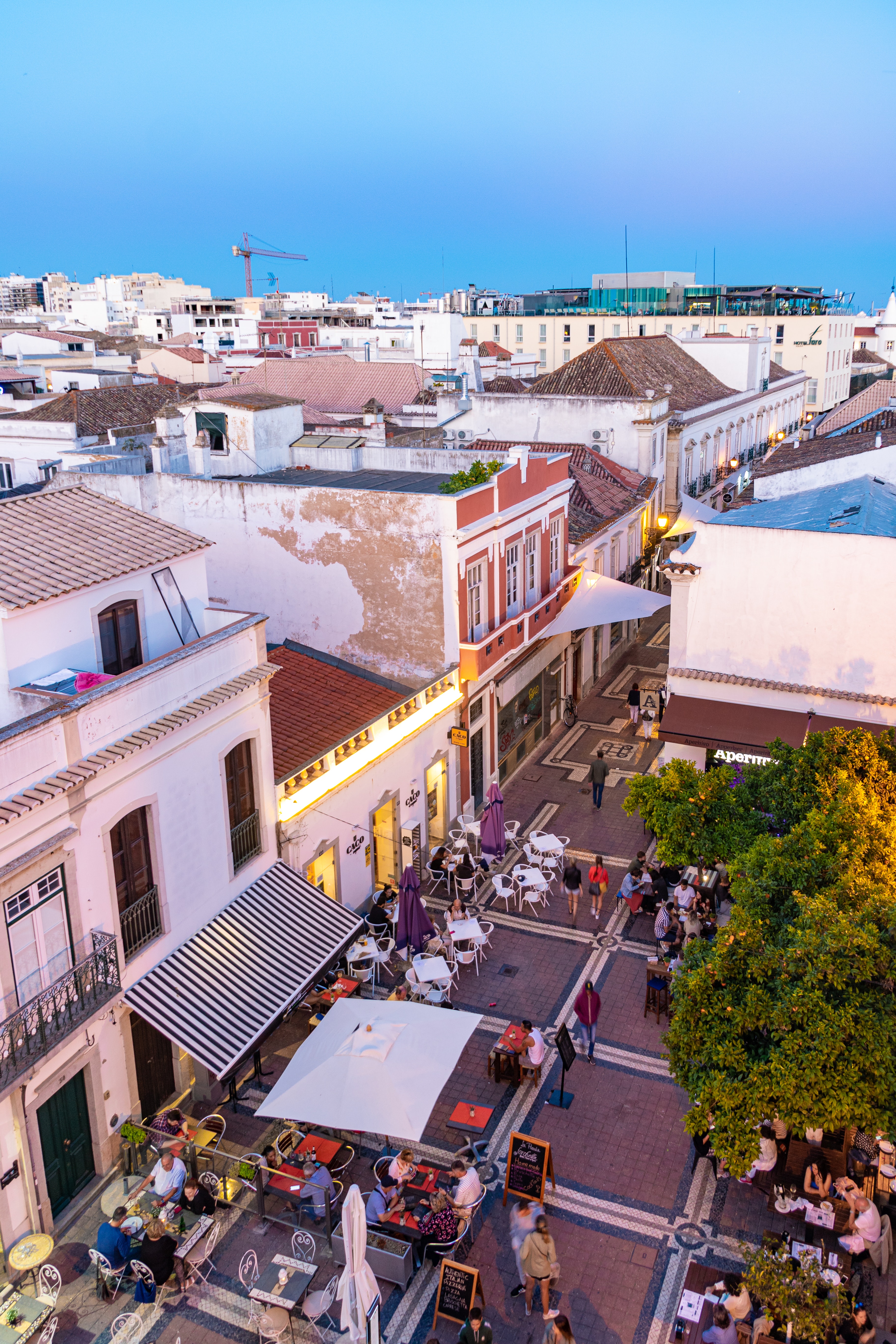
Ukshunubah! Well, Faro. Blame it on the Ossonoba…Photo by Magda Ehlers from Pexels

Obviously, you can’t just throw readers into a mix full of historical world-building with somewhat-informed but often-obscure editorial choices and expect them to sort it entirely for themselves. I created a notes-and-glossary for people reading it; some of the Dear Readers have told me that it is helpful, especially because al-Andalus isn’t a society that most of them have a great deal of specific knowledge about, some of them are not Muslim nor necessarily deeply familiar with Islamic practices so may have some religious/cultural things to wonder about, and some of the events of the story (in particular, the identity of the invaders) are things people don’t necessarily know about and may question: “Did that really happen? Where did you get the idea?”

The answer on that particular question about the invaders (as it’s a good example) is yes: it really happened, the invaders are who you think they are, Dear Reader, and writing about it was largely inspired by reading the passage about the Viking invasion of Ishbiliya in 844 in ibn al-Qutiya, and then seeking out more information about the invasion. ibn al-Qutiya also inspired the initial inciting event: in his chapter about Abd’ ar-Rahman II, he relates a story about a body found in a basket, how the emir* dispatched a visiting Hajji named Muhammed ibn Salim to investigate, how Muhammed ibn Salim found the culprit by tracking down the maker and buyer of the basket, and…the anecdote as written is less than a full page, but it made an impression on me. Essentially, it was detective work that was modern enough to be immediately recognizable as such, and that was fascinating to me. The emir had intended this investigation as a kind of test, a job interview if you will, and Muhammed ibn Salim passed with flying colors. But then, of course, I had to build around that. Muhammed ibn Salim was only mentioned briefly, with minimal detail, so I had to make him a character based on that scanty framework. I changed some details for plot reasons (ibn Salim was likely a provincial minor functionary, not a “jumped-up little Khazar secretary from Baghdad” as he describes himself, the culprits weren’t quite the same, surprise surprise, and I added detail) but that was the basis for the story.

The second anecdote, the one that inspired most of the supernatural shenanigans in the story (not that I needed much encouragement to make it supernatural because I am that cheeseball) was from the attack on the mosque of Ishbiliya (readiest source for readers: there’s a really good recitation of ibn Hayyan’s account up on YouTube, if you’re interested.) The Majus (Vikings) had, in the course of invading Ishbiliya, naturally wanted to burn down the newly-constructed fancy mosque. They attempted it, but were driven back by a glowing, beautiful youth who emerged from the direction of the minbar and fought them ferociously and tirelessly (and evidently freaked them out, because who wouldn’t be freaked out with some glowing dude popping up with a whole can of whoopass labeled “Viking Invader Repellent”); he did this on two subsequent occasions, the end result of which was that they left the mosque mostly unmolested. This account shows up in a couple of sources; theories on the origins of this fabulous and doubtless-apocryphal story have been written by people much better-qualified than I, largely about its mythical purposes. But I am an irresponsible person interested in writing fiction, so you bet I felt obligated to take that story and run with it. I ran a bit further with it than I intended, really, because the characters involved in that took on more life of their own than I had planned.

I do ramble, don’t I? Thank you if you’ve indulged me in this. That rambling gets to one of the problems I must tackle in this: imparting enough information to the reader that they understand what is going on, where it’s happening, and can also get immersed in the world and find it plausible, without having to read me going on at length about Vikings and Portuguese sardines in some blog post or forcing them to read more material.

Obviously, it’s not a bad idea to include a glossary and author’s note in a book, and perhaps even a map (I absolutely flat-out adore maps in books; if there’s a map, I’ll refer to it often while reading.) But I truly want people to get into the story and grasp what’s going on without having to keep checking a glossary the whole time, to suspend their disbelief in the story events without having to fact-check in the Author’s Notes (or beyond), and to not have to have read ibn al-Qutiya and ibn Hayyan (or even a modern work) to have a grasp on the society of al-Andalus. If people Google things and pick up books because they’re really interested and curious, that’s great; if people must Google things constantly, that’s not great, because it shows I haven’t done my job well enough to keep them following me through the story.

InchAllah I get somewhere close to that in making the story itself strong enough to stand on its own merits; I acknowledge there’s a lot of challenge to that because al-Andalus is a society that many readers aren’t going to be familiar with in great depth. But it is my job in this book to flesh that out and make it–or at least my odd version of it–more familiar.

* To answer the “emir/caliph” question, Abd’ ar-Rahman was an emir. The rulers of al-Andalus only became caliphs with Abd’ ar-Rahman III some generations later.

Writing and Self-doubt (Part I)

There are three things that have caused the most self-doubt in me in attempting to write this book: fear that it has no real readership (i.e., market), fear that I will get the history wrong in either small or fundamental ways, and fear that I will wind up writing something that cribs from someone else’s work, or basically repeats something someone else has done. I imagine these are things that pretty much every writer fears, although how much of each afflicts any given writer is probably subjective.

First, readership: I largely started writing this because it was a book I wanted to read, or at least, there were elements I wanted to see in a book that I had not found in combination anywhere, and I wanted to see them put together in a story that was relatively satisfying to me. But just because I want to read a particular book or find particular things interesting and worth exploring in fiction doesn’t mean that anyone else is clamoring for them. The book is a hybrid of genres: historical, mystery, fantasy. You have historical mysteries and historical fantasy as genres, why not all three at once? I mean, certainly, many books tend to have some kind of genre crossover, even genres that are hybrids to start with, but having all three might be a genre too many for some. Then there’s the topic: yes, people like historical fiction/historical mysteries, but the setting is less common and probably less appealing to many. If I were setting this in 9th century Britain, or 16th century Venice, or even just writing the main story from the Viking perspective, it would have greater appeal to a wider audience. I think (heck, I know) that setting any book in an Islamic-majority society, or with main characters who are Muslim, tends to lose a lot of Western readers. That’s a very large topic right there—that you can have Muslims in a story if they fill certain roles or act certain familiar-if-not-always-entirely-accurate tropes out that a large swath of readers are comfortable with, but not other roles—and worthy of its own discussion. Of course, that isn’t the only reason the ideas behind this might not appeal to most readers; maybe it’s too ridiculous, or not handled well, or maybe it’s that my story is really quite tedious. But there it is, and it’s inescapable: either it has broad enough appeal or it hasn’t. In the end, as far as getting it published goes, it doesn’t matter so much if it’s the most brilliantly written, historically accurate, fascinatingly plotted book possible if it isn’t something that people will want to read. That part I can’t control. Thus, just write it and see.

Second, historical accuracy: I fear that I have been writing something that is either riddled with small inaccuracies or has some larger historical flaw in a major premise. Should it be published, most readers are probably not going to notice small issues (and may even question some things that are actually accurate, and I already can guess a few of those), but there may be those readers…and I know this, because I have been one of them on occasion…who really do know the subject better than the writer. I know from experience that inaccuracies can pretty much spoil suspension of disbelief and mess up the story. Granted, there are two things to be said here in my own defense: one, I did a pretty fair amount of diligent research in world-building and fact-checking (for example, in the course of writing this, I have read four journal articles just on Andalusi plumbing, two of which were not in my native tongue) and can at least defend some of my questionable choices; two, unfortunately, there are some things just not known and one sometimes has to make educated guesses and take artistic license. Clothing, for example: there are very few extant garments from al-Andalus, certainly from this period (what we have is fragments of textiles, like tiraz bands); much has to be extrapolated from extant garments from other Muslim areas, or from art or written records. You can do a whole heap of research and still run into questions: here you are, trundling along, and you suddenly have to wonder: “Would people have been eating that? Are they sitting on chairs, or cushions? Yes, but were those perfume notes found in scents of the period? Would she have buttons on her sleeves, and was this color part of the dye palette of the time? How far away from this locale was that neighborhood in the 9th century? How many people fit into that kind of boat?” Sometimes I’d stop and look things up and try not to get sidetracked (fat chance); sometimes I’d recognize that sidetracking was far too likely, or that the answer wasn’t simple or readily found, or there were conflicting accounts…and I’d mark it as something to backfill later. Sometimes the answers just weren’t there, and sometimes if you don’t just keep writing you won’t write. On one or two occasions, I picked something that was possible even if not the most probable because it fit the story better (I tried not to do this at all, but I did create one character whose origins are improbable although not impossible.) I worry that someone will spot a particularly obnoxious, egregious, or utterly impossible flaw in the history, and it will be an utter disappointment to that person; I’ll get wind of their disappointment and possible scorn and feel very bad about it (getting ahead of myself in assuming it gets published and actually reaches the reading list of someone likely to feel disappointment and scorn in my historical flaws.) I made a lot of historical corrections as I went along and learned new things. It’s probably still error-riddled. At some point, I had to stop dithering and pulling out books and articles and just write.

Third, unintentionally plagiarizing/writing something someone else has done/doing something too similar to another writer’s work or that appears really derivative: this one terrifies me. As I said, I started writing a book based on what I wanted to read about and couldn’t find. I didn’t think this particular story had been told from these particular angles. In fact, finding anything written about this particular set of historical events was rare. And then as I was writing, the doubt started creeping in: well, Gaiman has done a lot of exploration of the nature of old gods no longer worshiped…could this wind up too American Godsish in theme, or like some arcs in Sandman? The only fiction I’m finding about al-Andalus seems to be written about the end of the era, about later in the era, or as part of the “clash of civilizations” (and mostly told from the Christian-Iberian POV), or is otherwise not like this…but is that all there is? I’m afraid that much of what is written by non-Muslim American and UK writers exploring Muslim culture of the period doesn’t feel authentic to me, however well-written it is otherwise; it feels as if they’re writing about something that they’re not really culturally comfortable/familiar with and they are sometimes over-relying on predictable tropes. I recognize that as a sweeping judgment, but I often do sense discomfort in authors uncertain of how to write these characters. Spanish writers have done much more with the era, which makes sense, and have a different mode of approach. I have to confess that my Spanish is now kind of rusty, and reading in Spanish takes about 3 times as long for me as English (my French is starting to get out of practice, too.) Am I rewriting someone else’s work unknowingly, only in English? Finding out what was out there in the first place was important, which meant exploring Spanish books in particular. Ah, look, Carlos Aurensanz wrote a trilogy of novels about the Banu Qasi; I’d better read at least the first one, since Musa ibn Musa shows up in my book, and it’s good to see what other writers have done with the period…all right; I’m not unintentionally treading all over Sr. Aurensanz’s work. Oh, and here’s Mario Villen Lucena’s 40 Dias de Fuego, about the Viking attack on Ishbiliya…ah, mierda, in the first chapter we are introduced to an Amazigh shepherd, uh-oh…O.K., whew, totally different book (warning: although it’s quite good, there’s a lot of graphic violence including depictions of sexual violence, which I tend to skip over when reading.) Back in the anglophone world, G. Willow Wilson has written a book set in al-Andalus featuring djinn. Oh, dear, I really like her stuff and I hope it’s not too similar in theme…well, it’s set at the fall of Granada. I will read it when I’ve finished writing this book (I’m reading and enjoying it now, matter of fact.) I don’t write in a particularly similar style, I think, and I’m clearly not being derivative of her. And so on. You get the gist. I could spend all of my time slowly reading Spanish novels and fretting about possibly surveying ground already mapped, or I could call it good and just write my book.

That’s many words I’ve written, all about the forces standing against me that happen to be in my own head when I have contemplated actually sitting down and writing a work of fiction that is set in a particular time and place, and has particular sorts of characters. Always there is the obnoxiously persistent voice, oily and overfamiliar, murmuring into my ear: How are you qualified to write about this in the first place? Why do you presume to do this?

Well, I probably am not “qualified.” And I might not have historical accuracy so flawless it stands as a masterwork of scholarship, at least regarding Andalusi indoor toilets*. I might not have a surefire bestseller which has themes that everyone can relate to and wants to read. I might wear too many inspirations on my sleeves, or be writing about events that other (better) writers have written books about. But regardless, I have just had to set all of that aside and say to the obnoxious voice, every time it pipes up: At least I’m actually writing it.

*These existed, yes, and there is evidence that they were ubiquitous: archaeological finds suggest that even poor homes in the city of Qurtuba had indoor plumbing. If you are time traveling and looking for a period that won’t be too difficult if you like hygiene and plumbing, al-Andalus is a good choice.

Reading list: al-Andalus

Someone asked me not long ago for books to read that I’ve used for research. Which sounds unwarrantedly pretentious, as an unpublished writer. But here’s the thing: I’ve done a fair amount of research, simply because I’m keen on the topic, and someone asked and I really need little encouragement to share. So to that end, here is a (likely to be expanded) list of books I’ve found helpful and interesting. I also have a Goodreads shelf of books, which includes fiction (some good, some so-so, some really good.) Some of these are about later periods, but even those are often very useful. My last job gave me unfettered access to its academic library (losing that access is one of the few regrets I had in leaving), so I also have used and consumed an…unusually high…number of academic articles, as well. There is so much that can be found with more-public access as well, like academia.edu and JSTOR, so do check them. But the following is a list of books I would recommend, from the introductory to the really specific.

The Tibyan: Memoirs of Abd Allah B. Buluggin, Last Zirid Amir of Granada: 11th century, but not only is it fascinating, it’s a pretty unique glimpse into the life and mind of a dethroned ruler near the end of his life. In writing royal characters, that insight is really helpful. This book, if you can find a copy, is very expensive. The academic library I had access to at my last job owned a copy, and I kept it out for as many renewals as I was allowed (2 or 3; I didn’t hog it.)

The History of ibn al-Qutiya (David James, ed.): 10th century. This one, fortunately, comes in an affordable edition. Two of the stories he relates inspired me to start this book (I’m not blaming him, mind; it’s really my own damn fault I wrote this.) I highly recommend it.

Kingdoms of Faith, Brian Catlos: A newer book, and a very good, readable history. Actually, this is my favorite general history.

Moorish Spain, David Fletcher: A classic work.

Revisiting Al-Andalus: Perspectives on the Material Culture of Islamic Iberia and Beyond, Glaire D. Anderson and Mariam Rosser-Owen: If you want to know (based on archaeological evidence) what al-Andalus looked like and how its people lived, this is essential reading. This book is one of my favorites, and one I used the most in trying to put together the world of the book. Warning, though: it is academic in nature, and not necessarily thrilling reading for people who just want the highlights.

A Vanished World: Medieval Spain’s Golden Age of Enlightenment, Christopher Lowney: Written more for a popular audience than an academic one, and quite good.

Granada: A Pomegranate in the Hand of God, Steven Nightingale: another less-academic work, also quite good as background reading, rather than more specific work.

The Ornament of the World: How Muslims, Jews, and Christians Created a Culture of Tolerance in Medieval Spain, Maria Rosa Menocal: Another popular work, and one that for some reason makes some people rather cranky (the scholarly quibbles are one thing, but much of the crankiness is actually unpleasantly ideological, so fie on that), but it’s a lovely book and a very good introductory read.

Defining Boundaries in al-Andalus: Muslims, Christians, and Jews in Islamic Iberia, Janina M. Safran: Exactly what it says on the tin. More academic. I think it’s a pretty essential read, though.

Conquerors, Brides, and Concubines: Interfaith Relations and Social Power in Medieval Iberia, Simon Barton: I read this when I was already beginning to edit my first draft; it’s an enjoyable if sometimes dense read.

Al-Andalus, Sepharad and Medieval Iberia: Cultural Contact and Diffusion, Ivy A. Corfis: Definitely more academic than accessible, and is occasionally quite esoteric. The topics range pretty widely, which makes for a more comprehensive volume. Worth reading.

Daily Life in the Medieval Islamic World, James E. Lindsay: Not Andalusi-specific, and I found it personally less useful than some of the other books I’ve listed, but a really good book to have on hand as reference if you’re going to write about the period.

A Descriptive and Comparative Grammar of Andalusi Arabic, Institute of Islamic Studies of the University of Zaragoza: I really lucked out in getting a copy of this, because like the Tibyan, it’s usually pretty dear. And maybe most people wouldn’t need this, but I’m ridiculously over the top about linguistic stuff, and I do love a good bit of wordplay however esoteric (I make a linguistic joke in the book that is possibly unforgivable and an editor would probably cut it.) I believe that understanding how people use language gives me insight into them as people. Hence I am including it on the list.

So that’s a list of books I’ve used and recommend, most of which I have copies of on my desk (or in my Kindle, in a few cases.) I’ve left off a good half-a-dozen that I will come back to and add, and there are books about later periods that are also really good reads for a broader scope of knowledge that I may also add to the list. And books about djinn, because I know people are keen on that bit.