This is my orange tree. Sprouted from a seed in 2017, he has grown to almost 5 rather leggy, awkward feet; he has stubbornly refused to make many branches, preferring to exert his energies into becoming one tall, spindly leafy stalk with two or three small branchlets like afterthoughts—and never where he was pruned, as all advice meant to coax him into making branches assured me would happen. As he sits in a very large pot on my front porch, I have had to explain to visitors what “that funny-looking tall plant” is. A month or so ago, however, I discovered that he’s decided to go in a different and exciting direction with his art, branching out at every node. And now he is starting to look like a tree. He’s not the glamorous bushy creature that my lime has become (I rescued that from the curb, where someone had left it after an unusual frost had battered it; it has rewarded me for not giving up on it by being quite a pretty lime.) He’s really kind of a punk.

This stubborn cuss of a plant is a Citrus aurantium, the bitter or sour orange, also known as the Seville orange, the ur-orange of the modern fruit found in your local grocery store. DNA studies indicate that the species originated in the foothills of the Himalayas and spread thence westward. The sour orange reached Europe via the Umayyads; it is said that Ziryab himself, 9th-century musical prodigy and influencer before influencers were a thing, introduced the convention of orange juice for breakfast (that may be anecdotal, but someone had to do it, after all.) The oranges get mentioned more than once in my book, because the oranges represent something fundamental in the heart and soul of al-Andalus.
…And, also, I am enamored of the sour orange. Web pages will caution you that they aren’t really good for eating (except in marmalade, say), but I know that not to be true. To take a bite of one may be a rude surprise to one expecting the sweetness of the Valencia, navel, or blood orange, but they have a depth and dimension to their sour assertiveness that, frankly, I love; I know other people who feel the same. Their skin is very firm and thick; they aren’t easy to peel. The fruit itself is heavily fragrant—in fact, the sour orange is commonly used in perfumery: the honeyed-light sweetness of the flowers with an undercurrent of decay makes orange blossom absolute; the sharp, assertive, woody green citrus of the leaves and stems make petitgrain; then there is the oil from the fruit itself, a burst of sweet, sharp, and juicy. When you peel one of these oranges, it’s important to really dig your nails into the rind to savor the lovely oil scent, so thick and heady it’s like rhythm.
Orange blossoms are one of the best smells in the world, and I will see no debate on that. Paradise is perfumed with orange blossom, in my conception of it.
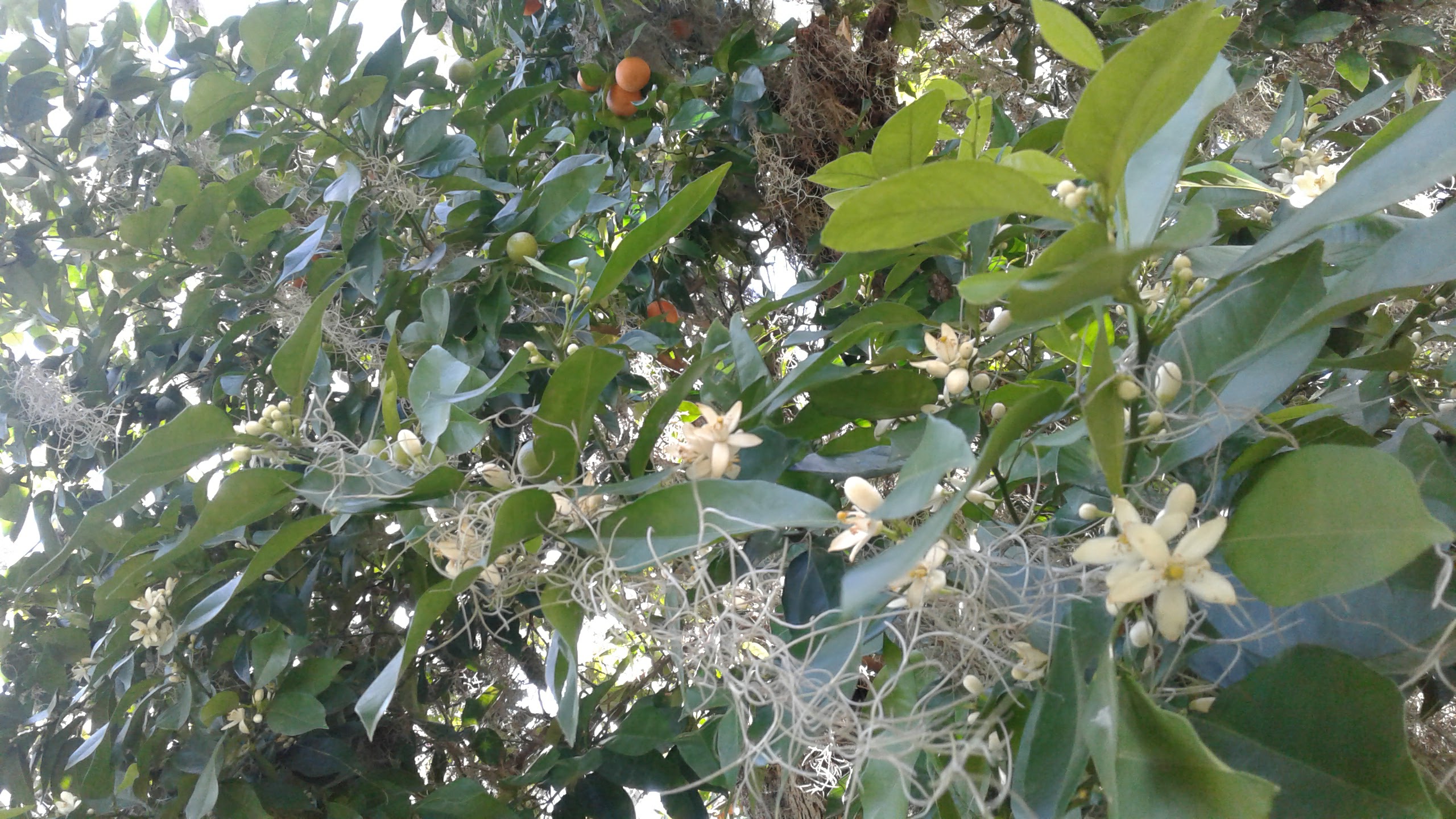
My tree was grown from a seed taken from a rather special tree. His progenitor lives on Sapelo Island, untended and mostly noted by visitors as a pretty novelty; as I mentioned, the fruit are not to most people’s taste, and tourists who pick the lovely fruit hoping for a sweet snack are usually disappointed (although the Gullah Geechee of Sapelo do use the sour-orange juice as a home remedy for coughs and colds; it’s mixed with honey, and, according to one of my friends, alcohol is usually involved.) There are five or six such feral sour-orange trees on Sapelo that I know of; this one is near the mansion, and by all rights should not be as impressive a tree as he is. He grows at the very foot of an ancient live oak tree; despite this formidable competition for resources, this orange tree is about 25 feet tall and not young. Every year, he scents the surrounding air with the benediction of his flowers and produces a beautiful crop of bright fruits. He’s a very hardy tree, having weathered numerous hurricane-and-tropical-storm seasons, half-hidden by the oak and not paid much mind except by the occasional strange person like me; I visited this tree regularly when I worked on the island (Hurricane Irma sent the island over a foot of storm surge; everything green suffered a bit from the inundation. He looked somewhat sad and drawn in on himself, so I took a bag of citrus fertilizer out there to him. I think it helped. Maybe.) Seville oranges are known for being tough and sturdy; they are often used as rootstock for sweet varieties for that reason (with age, the sweet oranges will “revert” to the rootstock; the oranges of such an aging tree are a bit dismaying. They taste like they should be sweet and they have the sweet-orange texture, but the flavor is bitter and chaotic, not sour and well-composed like that of a true Seville.)
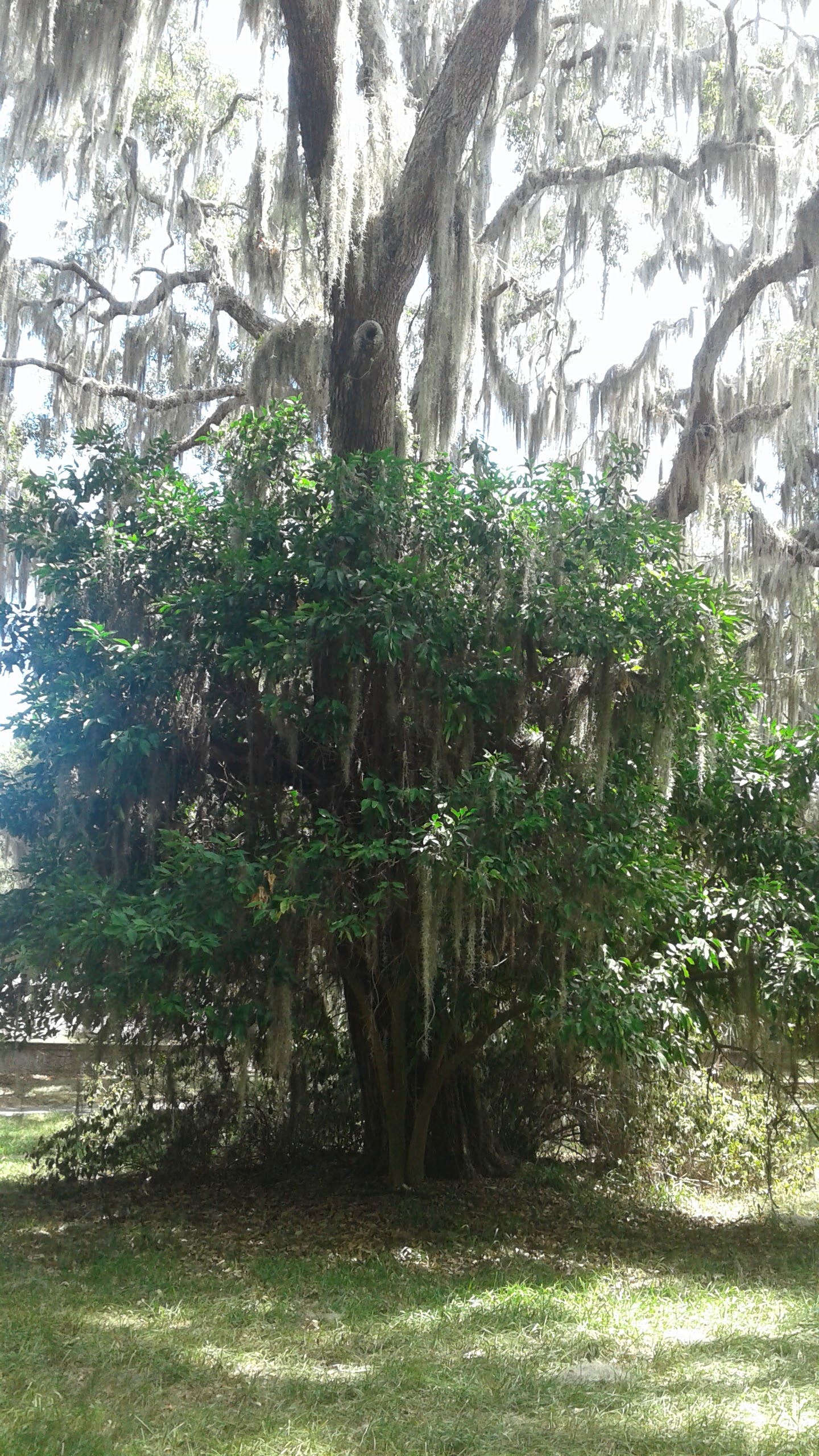
The live oak behind him is massive.
So what’s with the presence of feral Seville oranges on Sapelo, and elsewhere dotting the landscapes of Florida and coastal Georgia? The answer, of course, is the Spanish. The territory of La Florida comprised northern Florida and coastal Georgia in the 16th to 18th centuries. In the latter part of that era, coastal Georgia was “the Debatable Land,” with the English making inroads and the Spanish snatching back. The Spanish loved their oranges; there were even attempts to grow wheat and oranges as cash crops (see here for one discussion of this.) Sapelo was the site of one of the mission settlements that ranged along the coast of La Florida.
There were several such missions built during the late 16th-early 17th century period; the Mission de San Joseph de Zapala was in full use by about 1610, but I think it was started in 1594 (don’t hold me to that exact year; I’m too preoccupied right now to confirm it.) The Spanish moved in on the territory of the Guale people, who were already in the midst of a shakeup due to an epidemic and attacks by the Westo, a far-ranging tribe who had adopted a practice of capturing slaves from among southeastern peoples. The Guale had a settlement on Sapelo; the Spanish shouldered in and built their mission. Somewhat later, a group of Yamassee, who were likely refugees, moved onto the island as well. The Spanish interaction with the people of La Florida was always thorny (to put it mildly): Spanish exploration was explicitly “for cross and crown”; they were looking for riches and converts. Their view of the native people was not a good one; recall that this was the time of “limpieza de sangre” (purity of blood), a policy that viewed anyone with the “stain” of Muslim or Jewish blood as markedly inferior to “cristianos viejos”; I contend this ideology was a foundational template for modern white supremacy. Imagine how those who held that idea extended it towards indigenous Americans. True, there were those, especially among the Franciscans, who took a more benevolent stance, and people who have to live together at a small scale tend to learn to get along. Somewhat. But the Spaniards had their own agenda, which really wasn’t about seeing the people they encountered as equals.
Needless to say, the missions did have problems with uprisings from both the Guale and Yamassee (having read detailed accounts, I cannot say I blame them at all for rising up.) Furthermore, the missions were facing increasing incursions from the English, the English-backed (and armed) Westo, and French pirates. Over time, the mainland missions were closed and everyone therein moved to the island missions; eventually, all of the missions were consolidated onto Sapelo, as it was a defensible island. For a while. The Spanish eventually packed up in 1684. They did return in 1686 to drive off a settlement of Yamassee who’d remained near the old priest’s house (why did they drive them off? Spite?), and destroyed the remains of the mission and settlement. Including the groves of orange trees. The Englishman Capt. Dunlop, in his “Voyage to the Southward,” wrote of what he saw in 1687:
“Moving early we came about noon to Sapale…where we see the ruins of houses burned by the Spaniards themselves. We see the Vestiges of a ffort; many great Orange Trees cut down by the Spaniards in septr last…but all had been burned to Ashes last harvest by themselves…”
One can destroy a grove of fully grown trees, but there are always seeds.
These random feral sour oranges on the island are not the very trees a Yamassee or Spaniard picked fruit from, mind, as oranges don’t usually live to be 400 years old (there are rare examples of very old sour orange trees, but those have been cared for conscientiously for many years; it must be a remarkable burden to have to be mindful of one’s stewardship of an ancient living thing.) These were likely rooted from a seed dropped by a bird at the foot of a live oak, or a fruit eaten by an animal and then excreted. They are all tough cusses, living out their lives mostly ignored in a mostly wild landscape, each year offering the dazzling sweetness of their blossoms to the air and the bees, their perfumed and rough-skinned sour fruit to any creature who will eat them.
I am fascinated by the concept of epigenetic memory: that what an organism’s ancestors lived through survives in and alters its genetic patterns; it’s a more empirical (and therefore more respectable to those who may scorn the “fuzzier” concepts) form of ancestral memory. Like the dog or Bombyx mori, the orange tree is a species cultivated by humans. We have altered it on the genetic level so that it has adapted to us; therefore, I’m sure we are part of its epigenetic memory. Like the dog and the silkworm moth, then, it has an existence that is not ours and is apart from us, but it must on some level always be aware of us, the species that has etched our collective name in its DNA. I imagine these trees collecting and cataloging their memories of all of the people who have lived on the island–the generations of Gullah Geechee families, the rich men of the mansion, the doomed 18th-century French entrepreneurs, the Guale and Yamassee people, Captain Dunlop, the Spanish soldiers and priests. I imagine their roots holding the memory of the sunwarmed and well-watered soil of a garden in al-Andalus, or of being a dreaming seed carried westward in a pouch or pack along the Silk Road. It may be fanciful and even twee of me to say that, but on some level we all acknowledge the potential sentience of trees: there is a reason we all understand the concept of witness trees, trees which were present during a significant event in a significant place, and have survived long years since. These trees are landmarks in and of themselves, and we may touch the bark of a tree which was present at a particular time and wonder what it experienced and what it remembers.
My young tree unfurls his tender new leaves to the sun, having stretched himself out to what he deems a currently satisfactory height, no longer such a “funny-looking plant.” There are at least 3 other such young trees sprouted by me from seeds from that sturdy tree (one of the most sentient trees I’ve ever seen) and given to other people. They’re doing well. My tree hasn’t made blossoms and fruit yet, but I have a suspicion that will be coming soon. He’s flourishing, and I may have to get him an even bigger pot (at this rate, it’s going to have to be some massive vat soon; I’m living in a rental and I refuse to put him into the ground here.) He’s already got a very big pot and he seems quite content right now to grow and hold fast to whatever memories his family holds.

 Maryam Payne, Writer & Editor